
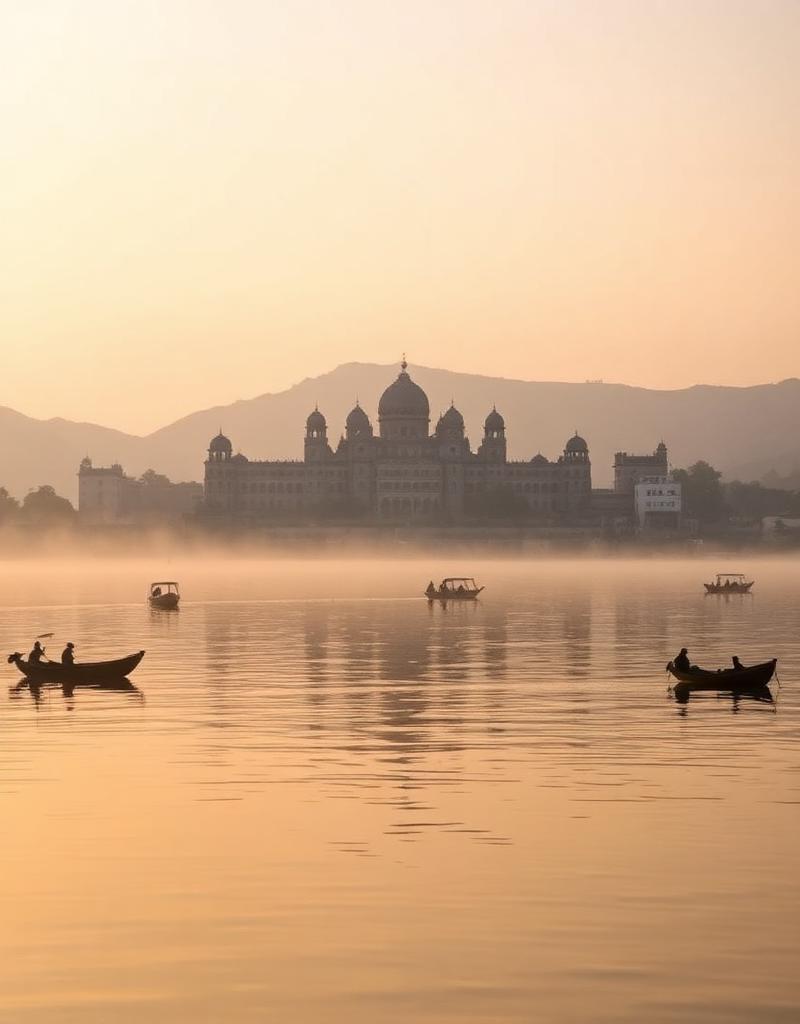
The Hour Mewar Light Turns Forgiving
Every Udaipur mehndi has a single, narrow hour that decides whether the evening will feel like Mewar or like a hotel ballroom on assignment in Rajasthan. It is the hour the city's light turns forgiving — roughly 5:30 in winter, 6:30 in summer — and it lasts about forty minutes. The mehndi that begins inside this hour rides on the city's own register. The mehndi that begins after dark, with the lamps doing all the work, has to manufacture an atmosphere the building was about to give it for free.
Forgiving is the right word. Mewar's late-afternoon light has a specific quality — slightly amber, slightly hazy from the lake, soft enough that no one in the family looks tired and the bride's grandmother does not need to be photographed against a backlight. Skin photographs well. Sandstone glows. Marigold reads warmer. The hour costs nothing and gives back more than any uplighting rig.
The first scheduling decision in a Udaipur mehndi is therefore not the music or the menu. It is the start time. Most planners default to "after dark" because it gives décor teams more room to work, and because they are used to ballroom timings where the building doesn't matter. In Udaipur, the building always matters. We push, gently, for the mehndi to begin at the hour the light is on its way out — guests arriving in the last twenty minutes of daylight, the henna artists already at work, the music starting as the sky moves from amber to indigo.
This means the décor team has to be set by 4:30. It means the photographer is shooting golden hour for half the event, not just the bride's portrait. It means the bride and her cousins, having had their henna started in daylight, are not exhausted by the time the music begins. None of these are small advantages. They compound.
If the venue does not allow daylight access for the décor — a real constraint at some of the working palaces — the workaround is to scale the décor down to what can be set in 90 minutes after the previous event clears, and to start the mehndi exactly at sunset rather than waiting for full dark. The instinct to "let the lighting do the work" is the one to resist. The lighting is supplementary. The light is the event.
A mehndi that feels like Mewar begins not when the music starts, but at the hour the light turns forgiving.The House of Udaipurs
The Music: Live, Local, Restrained
The single fastest way to make a Udaipur mehndi feel like every other sangeet you've been to is to fly in a Mumbai DJ and let him programme the evening from a laptop. The single fastest way to make it feel like Mewar is to book one local musician — a sarangi player from the Gangaur Ghat workshop, a Manganiyar singer from the Marwar circuit, a small Mewari folk ensemble — and to let them play, restrained and live, for the first ninety minutes.
The reason works on two levels. The obvious one is acoustic. A sarangi played live in a haveli courtyard sits inside the building's own resonance — the walls were built for human voice and string, not amplified bass — and produces a kind of sound that Bluetooth speakers cannot reproduce no matter what they cost. Guests notice within ten minutes. They stop checking their phones.
The deeper reason is editorial. Live local music sets a register the rest of the evening has to follow. The conversation slows down. The drinks order gets gentler. The henna artists, who cannot work at speed when there is dance music playing, finally settle into the rhythm they need. By the time the second half of the evening shifts into a curated playlist or a small DJ set for actual dancing, the wedding has earned the shift — it is not starting on it.
Restraint matters as much as authenticity. A folk ensemble at a Udaipur mehndi should be three or four musicians, not eight; one vocalist, not three competing for solos; a setlist that includes actual Mewari and Marwari pieces, not just the Bollywood-adjacent crossover that bands learn for tourist circuits. The right musicians are the ones who can be told, "we want a piece that is genuinely from this region — not the song from the Padmaavat soundtrack" — and who can deliver it without negotiation.
For the dance portion of the evening, which usually begins around 9 pm, the same rule of restraint applies. A short, well-curated DJ set — ninety minutes, not four hours — keeps the mehndi from collapsing into a generic sangeet. The wedding's heaviest dance night, if there is one, belongs to the next evening. The mehndi is, by tradition, the slower wedding event. Plan it that way.
The Mocktails That Aren't Pretending to Be Cocktails
A Udaipur mehndi is, for most families, a daytime-into-evening event with a meaningful number of grandparents, children, and observant guests in the room. Alcohol — if it is served at all — is usually held back for the sangeet or the wedding-evening dinner. Which means the mehndi's drinks menu is, by default, a mocktail menu. And mocktail menus, in Indian weddings, are almost always done badly.
The badness has a specific shape: a "virgin mojito" served in a tall glass with too much sugar; a "non-alcoholic sangria" that tastes like fruit punch; a "shirley temple" being given to children with the air of a consolation prize. None of this belongs at a wedding that has spent two crores on its venue. The drinks menu deserves the same thinking the food menu got.
What works, in a Udaipur mehndi, is a short drinks menu — three or four offerings, no more — that draws on the region's actual non-alcoholic traditions and treats them as adult drinks rather than concessions. Kesar badam milk served chilled in small kulhads. A spiced jaljeera with fresh lime, mint and roasted cumin. A rose-and-saffron sherbet. A chilled chaas with a curry leaf and a hint of asafoetida. None of these is pretending to be a cocktail. All of them are sophisticated, regional, and quietly correct for the hour and the temperature.
The presentation matters as much as the menu. Brass tumblers, small kulhads, glass goblets in coloured uranium glass — anything except plastic flutes. A drinks bar that looks like a hotel banquet bar with a "non-alc" sign taped to it will be ignored. A drinks station that looks like the corner of a Rajasthani household — a marble slab with brass jugs, a basket of fresh limes, a small mortar of green elaichi pods — is photographed by every guest within ten minutes of arrival.
For families who do want alcohol available — discreetly, for the friends-of-the-couple corner of the room — the answer is a small, separate bar tucked into a side terrace, never the centrepiece. It serves a short list: one Indian gin, one whisky, one wine. Anything more ambitious will compete with the regional drinks for attention and lose the editorial battle. The mehndi belongs to the kesar badam. The sangeet, the next evening, can belong to whatever the bar wants to be.
The right décor for a haveli rooftop is the décor that disappears five minutes after the lamps come on.
The Décor That Doesn't Apologise to the Building
Every Udaipur mehndi décor brief written by an out-of-town team includes the same five words: marigolds, jasmine, mirrors, leheriya, candles. None of them are wrong. All of them, used heavily, will overwhelm the venue. The discipline is to use them lightly enough that the building remains visible underneath.
The right décor for a haveli rooftop is the décor that disappears five minutes after the lamps come on. A row of marigold strings along one balustrade — not all four. A scatter of low brass diyas across the seating area — not a continuous illuminated path. A single statement leheriya canopy over the bride's seat — not three competing fabric installations across the courtyard. The building has been doing wedding atmosphere for four centuries. The décor's job is to support that, not to replace it.
Florists who have worked in Udaipur for a decade understand this. Florists arriving from Delhi or Mumbai, used to ballroom briefs, often do not — and the polite battle on the day of the event is the one between the bride's planner trying to remove half the installations and the décor team trying to defend their estimate. The way to avoid this battle is to specify, in the décor brief, the venue's own aesthetic as the constraint. "The frescoes must remain visible." "The carved jharokhas must not be covered." "No structure can be anchored to the marble." The right teams take this in stride. The wrong teams quote a 30 percent surcharge for "creative limitation," which is a useful filter.
Lighting, more than flowers, decides the décor's success. The right lighting for a Udaipur mehndi is warm, low, and from many small sources rather than a few large ones. Diyas everywhere — in shallow brass urlis, along the steps of the courtyard, lining the balustrade. Strung pendant lamps in copper or amber glass. A few uplights against a single fresco wall, no more. What does not work: theatrical wash lights, colour-changing LEDs, projection mapping. The building does not want to be a screen.
Finally, the seating. Most Udaipur mehndis are still set with low gaddis and bolsters around small marble or brass tables — a thoroughly authentic, thoroughly photographable arrangement that almost no chair-and-table dinner can compete with. Plus, low seating signals to guests, before any music has played, that the evening is meant to be slow. Knees on cushions. Children running between the bolsters. Henna artists working at floor level. A grandmother quietly reigning from the most cushioned corner. The whole point of the evening, set in three pieces of furniture.
The Last Hour, Which Is the Whole Point
Like every good Udaipur wedding event, the mehndi's most important hour is the one most planners forget to design for. It is the hour after the curated programme ends and before the guests reluctantly leave — somewhere between 10:30 and midnight, depending on when the evening began. By this hour the henna is mostly applied, the music has shifted gentler, the food has been cleared, and the rooftop has settled into the warmest version of itself.
Plan for this hour. Do not assume it will happen on its own. The kitchen should be told to keep the chai station open until midnight. The bar (whatever its size) should slow rather than close. The musicians should be paid for the full duration even if they are only playing softly. The lighting should be allowed to dim — not switch off — so the courtyard moves from event-lit to ambient-lit naturally. The photographer should be told, explicitly, to put his camera down at 11.
What happens in this hour, when it is allowed to happen, is the part of the wedding the family will remember in five years. The bride's college friends finally have her to themselves. The groom's parents talk to the bride's grandparents in a way they have not had time for during the day. A cousin sings something unrehearsed. The henna artist explains a motif to a child. The night becomes the kind of evening it could only become because the planning let it.
The mehndi ends, traditionally, with the bride's hands being wrapped in old cotton — a small, quiet gesture that signals the public part of the evening is over and the women of the family will sit with her until the henna sets. Allow this moment its full weight. Clear the rooftop of vendors. Let the family carry the moment without an audience. The next morning's photographs will not have it. The family's memory will have nothing else as clearly.
Music, mocktails, Mewar light — and an hour at the end that the schedule does not interrupt. That is the entire mehndi playbook. Done with restraint, it produces an evening that feels indelibly, specifically of this city. Done with excess, it produces an evening that could have been held in any banquet hall in any city in India, with marigolds shipped in for atmosphere. The choice, all four nights of a Udaipur wedding, sits in the same direction: trust the building, trust the light, trust the region's own vocabulary, and add as little as possible.