
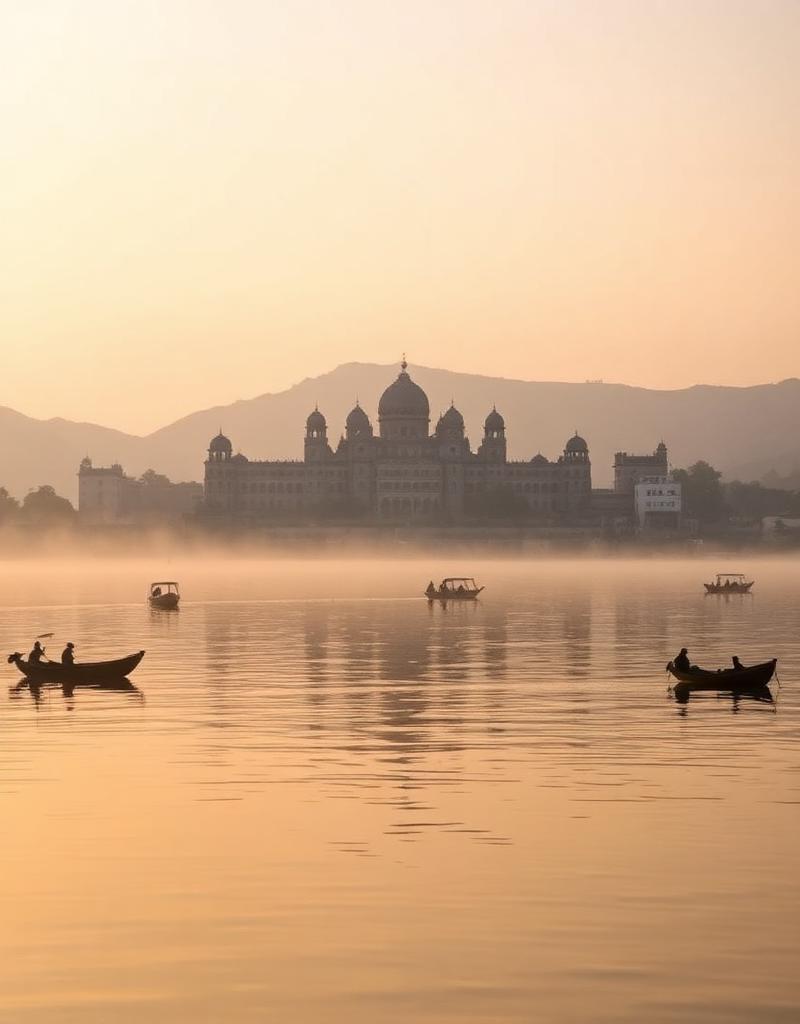
Two Cities, One Map
Udaipur in July and Udaipur in December are not the same city. They share a map, a palace, a lake — and almost nothing else. Choosing between them is not a question of weather. It is a question of which city you want your wedding photographs taken in.
Most families arrive at the question backwards. They pick a date that suits two sets of grandparents in two distant cities, then ask the planner whether Udaipur "works" then. The honest answer is that Udaipur works in every month, but it works differently. The same courtyard in August holds a wedding that smells of wet earth and jasmine. The same courtyard in December holds one that smells of woodsmoke and marigold. Both are beautiful. Neither is the other.
The mistake worth avoiding is treating the seasons as a binary — monsoon for romance, winter for safety. Udaipur's calendar is more interesting than that. There is a slow July of dense green, a theatrical August of sudden cloud, a soft September that locals quietly consider the city's secret month. There is a brittle November that turns golden, a crowded December that books out a year ahead, and a forgiving February that almost no one outside Mewar uses well.
Before you compare the two seasons, it helps to remember what you are actually comparing: not just temperature charts, but two distinct cinematic registers, two different guest experiences, and two very different conversations with vendors.
Udaipur in July and Udaipur in December share a map, a palace, a lake — and almost nothing else. The House of Udaipurs
The Light, Honestly Read
Light is the first variable, and the most underestimated. Photographers who have shot Udaipur for ten years will tell you that the city has two signature lights, and the wrong one will quietly undo your wedding album.
Monsoon light is diffused. Cloud cover acts as a permanent softbox, flattening shadows and saturating colours. Greens deepen, ochres warm, marigolds glow against grey water. Skin reads gentle. Brides photograph beautifully even at noon, an hour that winter weddings learn to fear. The cost is unpredictability — a sudden hour of hard rain can flatten a baraat that took six months to choreograph.
Winter light is theatrical. December and January mornings begin with a low golden raking light that turns haveli walls amber until ten in the morning, and again from four in the afternoon until sunset. The midday hours, however, are bright and unforgiving — high sun, hard shadows, and a thin haze that local photographers call "the white sheet." Winter weddings are won and lost by how well their schedules respect this two-shift light.
The practical implication is unromantic: monsoon weddings can shoot at almost any hour and look painterly. Winter weddings must be choreographed around two narrow windows of golden light. Either is workable. Pretending they are equivalent is what produces the wedding albums families quietly never print.
The Lake That Decides Everything
Lake Pichola is not a backdrop. It is a participant. Whether it is full, half, or quietly receding decides the geography of half the city's wedding venues — the island palaces, the ghats, the boat processions, the rooftop dinners that look out over water rather than mud.
A good monsoon refills Pichola by mid-August. By September the lake is generally at its highest, ghats are submerged at their lower steps, and the islands appear to float at the height a postcard would draw them. A weak monsoon, however, leaves the lake noticeably low through the entire winter season — and the same island wedding photographed from a boat suddenly shows fifteen feet of pale, exposed bank below the palace walls.
This is the conversation no brochure starts. Winter weddings book themselves a year in advance, in part, by gambling on the previous monsoon. Families who marry in December 2026 are quietly betting on the rainfall of July 2026. Most years the bet pays. In drought years it does not, and the same venue that promised a lake-edge dinner serves it on a terrace overlooking damp rock.
The monsoon wedding has the opposite arithmetic. The lake is, by definition, full or filling. Boat processions look the way Mewar poets described them. The risk shifts from water to wind: a heavy afternoon downpour can briefly close lake-craft operations, and a baraat that was meant to arrive by boat occasionally has to arrive by car. Good monsoon planners build a parallel land plan into every ceremony, and never tell the bride about it unless they have to use it.
A useful question to ask any venue, in either season, is simple: "What will the lake actually look like on my date, based on this year's rainfall?" Honest venues will answer in centimetres. Less honest ones will answer in adjectives.
Families who marry in December are quietly betting on the rainfall of July.
Guests, Logistics, Pricing
Guest comfort is the second axis. Winter Udaipur sits comfortably between fourteen and twenty-four degrees through the day, and dips to a sharp seven or eight at night. Outdoor dinners require shawls, fire pits, and a quiet warning to women in sleeveless lehengas. Older guests generally find winter easier — but the cold evenings catch many coastal-Indian and South-Indian families off-guard.
Monsoon Udaipur sits between twenty-three and thirty-one degrees, with high humidity. Outdoor ceremonies are warm but rarely punishing, especially after the afternoon rain breaks the heat. The genuine comfort question is mobility: wet stone steps in havelis, slippery ghats at the lake's edge, and the small but real risk of a guest in delicate footwear taking a fall. Good monsoon weddings invest in discreet anti-slip mats and a quiet usher at every staircase. Bad ones don't, and pay for it in a single phone call.
Pricing is the third axis, and the one most planners are evasive about. Winter — broadly mid-November through mid-February — is peak season. Heritage venue rates rise by thirty to sixty percent over base. Florists, photographers and decorators are booked nine to twelve months out, and almost none of them negotiate. December dates at the marquee island venues are routinely held a calendar year in advance.
Monsoon — June through early September — is, by most definitions, off-peak. Venue rates can be twenty to forty percent lower. Vendors have time, attention and willingness to customise. The same florist who quotes a stiff number for December will quietly co-design a monsoon mandap with you over three coffees in August. Families who care about texture more than calendar discover that monsoon weddings often feel more bespoke for less money — provided they accept the weather risk honestly.
The shoulder months — late September, October, late February, March — are where many seasoned families now quietly cluster. The lake is still high from the monsoon, the air is mild, the venues are available, and the prices have not yet hardened into peak. Anyone willing to look beyond the December–January block usually finds the best wedding they can afford.
- July – Early September · Deep Monsoon
- Soft diffused light, full lake, lush greens. Lower vendor pricing, real weather risk. Best for intimate, photographic weddings with a parallel indoor plan.
- Late September – October · The Secret Window
- Lake at its fullest, monsoon retreated, mild evenings, prices not yet at peak. The locals' favourite month.
- Mid-November – Mid-February · Peak Winter
- Theatrical golden light, brisk evenings, full vendor calendar. Highest pricing, longest lead times. Books a year ahead.
- Late February – Early April · The Quiet Shoulder
- Warm days, cool nights, palaces still photogenic. Good availability, soft pricing — and almost nobody using it.
The Quiet Recommendation
If you ask the planners who have done this for two decades — privately, off the record — most of them do not name December. They name late September, the second half of October, and the first ten days of February. These are the dates they themselves would marry on. They carry the lake of monsoon, the light of winter, and almost none of either season's risks.
The honest framework is this. Choose monsoon if your wedding is small, your photographer is patient, and the texture of the day matters more to you than its predictability. Choose deep winter if your guest list is large, your grandparents are elderly, and you need the comfort of a calendar that almost guarantees clear sky. Choose the shoulder months if you want, quietly, the best of both.
A bride from Bangalore who married in late September two years ago described it best. "I wanted the lake of August and the light of December," she said. "I picked the week between them. The photographs look like a season that doesn't exist on any calendar."
That, in the end, is the secret of choosing a Udaipur wedding date. The city offers two famous seasons and, between them, four quieter windows that almost no one fights for. Pick honestly — for your light, your lake, your guests, your budget — and Udaipur will arrive on the day already dressed for it.