
The Studio, Not the Classroom
Three of the surviving master miniature painters in Udaipur — a fourth-generation atelier near Jagdish temple, a fifth-generation family on the western lanes of Hanuman Ghat, and one independent master near Bagore-ki-Haveli — open their working studios to private students by appointment.
These are not classrooms. There is no easel rented for the day, no kit unpacked from a cupboard. You sit in the actual studio where the master works, on the same low cushion, in front of the same north-facing window, with the same brushes and the same pigments. The lesson begins almost without ceremony.
The brush is not a pen. The hand learns this in fifteen minutes and unlearns it for the rest of the afternoon.The House of Udaipurs
The First Hour: The Materials
Most of the first hour is spent not painting. The master shows you the materials, in the order in which they were taught to him, exactly as he was shown them as a boy.
Paper: handmade wasli, four sheets pressed and burnished. Brushes: squirrel hair, the finest with a single hair at the tip. Pigments: still mineral. Lapis lazuli for blue. Cinnabar for red. Malachite for green. Turmeric for yellow. White from crushed conch. Black from lampsmoke.
You will mix one or two pigments yourself, with gum arabic, on a small marble slab. The colour you are about to use will be a colour you have made. This is not a stunt; it is the only way the rest of the lesson makes sense.
The Second Hour: The Outline
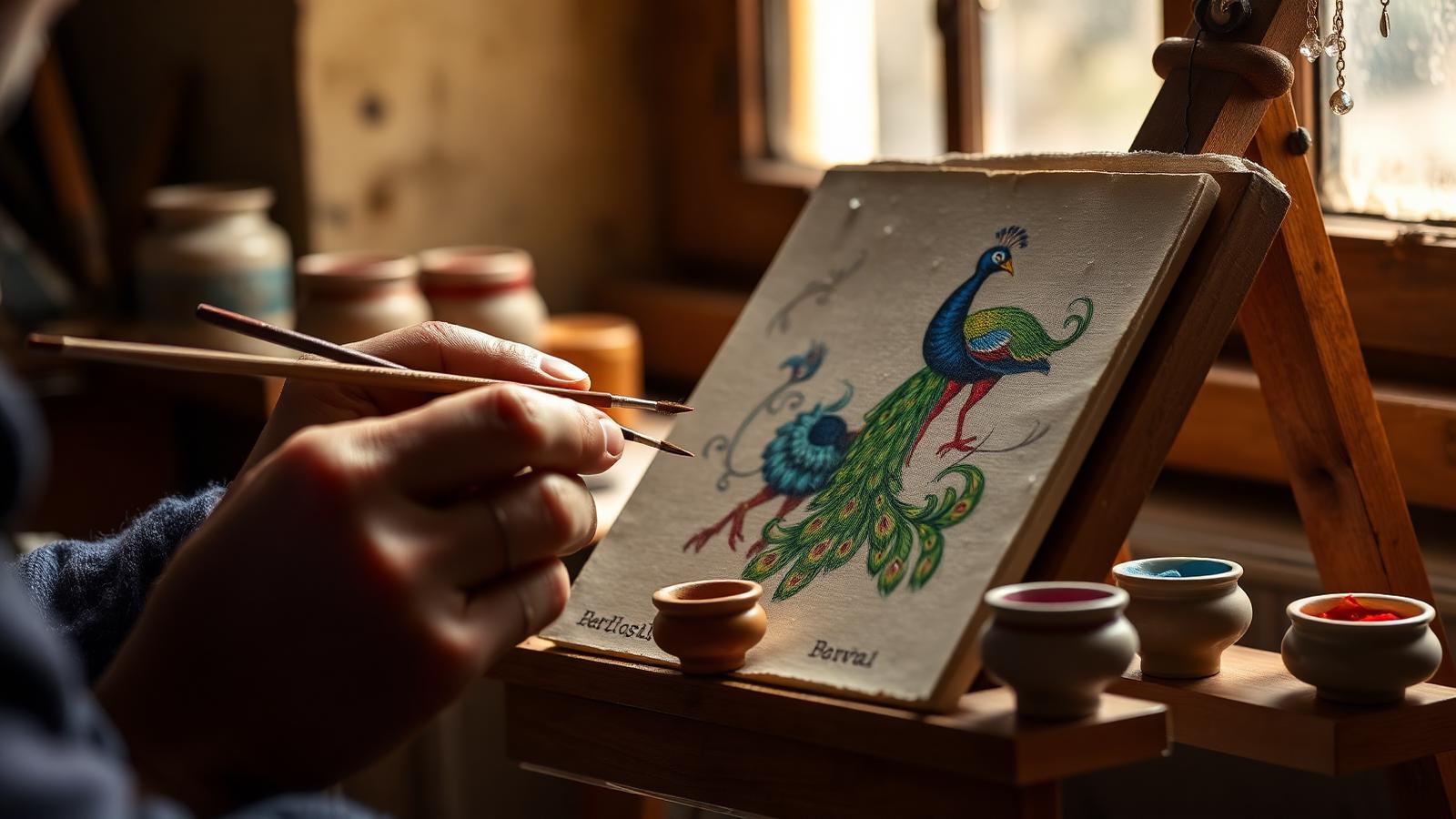
You will trace, then redraw, then paint a single image — almost always a peacock or a stylised Mewar lotus. The master will draw the outline first on his sheet, slowly, naming each curve. You copy on yours.
This stage is harder than it looks. The Mewar tradition is precise: the eye of the peacock, the angle of the crest, the swelling of the breast — each follows a rule that the master will explain without making a fuss of it. You will redraw twice. The third attempt will be acceptable.
Then the first colour goes on. A pale yellow wash on the body. The brush at this stage is held almost vertically; the pressure is almost nothing. The hand learns very quickly that the brush is not a pen.
- Duration
- Three hours, one-to-one. Two-person sessions are available with the same master at most studios.
- Indicative cost (2026)
- ₹3,500–₹6,500 per person, including all materials and the finished panel.
- What you take home
- One signed, dated wasli panel of a peacock or lotus, rolled and protected for travel.
- What to wear
- Comfortable clothes you can sit cross-legged in; the studios use floor cushions, not chairs.
A peacock takes three hours. The Mewar school has always been a school of slowness.The House of Udaipurs
The Third Hour: The Detail
The final hour is detail work. Layer by layer the peacock takes form: green over yellow on the neck, blue over green on the chest, the eyes of the tail feathers added one by one with the single-hair brush.
You will not match the master's panel. Of course you will not. But the panel you finish — small, slightly irregular, painted by you with pigments you mixed yourself — is yours. It is signed by the master in one corner and dated in the other. It travels home rolled.
More than the painting, what you take home is the speed at which it was made. Three hours for one small bird. The Mewar miniature tradition has always been a tradition of patience, and you will have spent a long, very quiet afternoon learning what that means in the muscles of your right hand.