
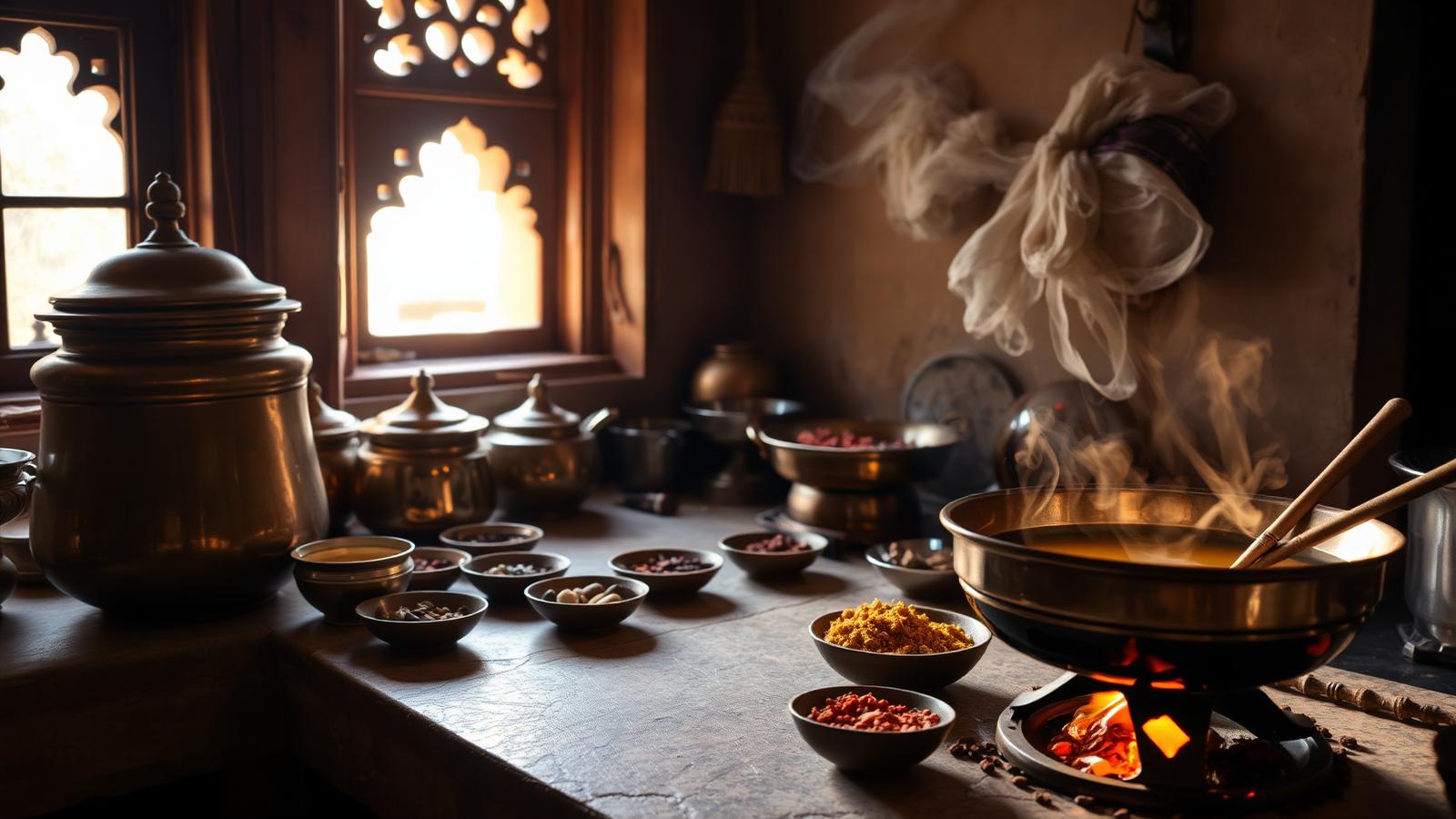
Why a Working Kitchen, Not a Hotel
Almost every Udaipur five-star hotel offers a "royal cooking class". They are pleasant. They are also, almost without exception, a one-hour demonstration in a sanitised kitchen where a junior chef cooks two simplified dishes in front of you while you sip cardamom tea and take photographs.
The class described here is the opposite. Two small operators in Udaipur — one a former palace cook, one a great-granddaughter of a Mewar royal-household chef — run private classes in their own working family kitchens. The kitchens are real: brass vessels actually in use, a clay tandoor in the courtyard that has been fired for thirty years, the smell of ghee that lingers because ghee has been cooked here every day for a generation.
You will spend four hours, not one. You will cook three dishes, not two. You will sit down to lunch at the family's dining table afterwards. You will leave understanding what palace Mewar cooking actually is, in a way that no hotel demonstration can transmit.
Spice marks the recipe. Ghee makes the dish. Mewar has always known the difference.The House of Udaipurs
The Three Dishes
The class teaches a fixed trio: one slow-cooked main, one bread, one accompaniment. The trio rotates seasonally, but the structure is fixed because it represents, in three gestures, what a Mewar royal table actually looked like.
The slow main is almost always lal maas — the famous Mewar mutton curry, dark with mathania red chillies, slow-cooked for two hours in pure ghee with whole spices and curd. You will sear, you will bloom the spices, you will add the meat in stages, you will not rush the slow cook. This is the dish that requires the most patience and gives the most back.
The bread is bajra roti — the millet flatbread of rural Rajasthan, kneaded by hand with hot water, slapped between palms, cooked on a flat tawa and then briefly on open flame. Easy in description, hard in practice. You will fail once and succeed twice.
The accompaniment changes with the season: in winter, gatte ki sabzi (gram-flour dumplings in yoghurt curry); in summer, ker sangri (a desert-bean preparation); in monsoon, a simple papad ki sabzi. Each takes thirty minutes and shows a different side of the Rajasthani vegetarian tradition.
The Politics of Ghee
A point the chef will return to, again and again, across the four hours: ghee. Not spice, not chilli, not cream — ghee is the actual signature of Mewar royal cooking.
The lal maas you are cooking will use roughly four tablespoons of ghee per kilo of meat. The bajra roti will be brushed with ghee at the table. A small dish of pure ghee will sit beside your final plate, to be added at the diner's discretion. This is not excess; it is structure. The ghee carries the spice, slows the cook, and softens the chilli — the chilli that, without ghee, would be inedible.
The chef will pour you a teaspoon of pure ghee at one point and ask you to taste it neat. It is sweet, almost nutty, with a faint smell of toasted milk. Ghee made this way — slow, in small quantities, from the milk of a single herd — is genuinely a different ingredient from supermarket ghee. The class is, in part, an apprenticeship in noticing this.
- Duration
- Four hours including the sit-down lunch.
- Indicative cost (2026)
- ₹6,500–₹9,500 per person, all-inclusive of ingredients, recipe card, spice blend and lunch.
- Group size
- Private (1–4 guests). Larger groups split across two sessions.
- Dietary notes
- A fully vegetarian variant is offered with the same structure (gatte, bajra roti, ker sangri). Tell the operator at booking.
A cooking class is one hour. A Mewar afternoon in a working kitchen is four. The difference is the entire point.The House of Udaipurs
Sitting Down to Lunch
The class ends with a meal — never a demonstration, always a meal. The dishes you have cooked are served at the family's own dining table, on brass thalis, with the rotis kept warm under a cloth.
You will eat with your right hand, in the Mewar way. The chef will sit with you. Conversation, by this point in the afternoon, will be easy. You will eat slightly more than you intended.
You leave with the recipes — handwritten in English on a printed card — and a small steel dabba of the spice blend used in the lal maas, sealed for travel. The total is four hours. Four hours, three dishes, one slow afternoon. It is, by some distance, the most useful Mewar meal you will eat.