
The Oldest Royal Sport
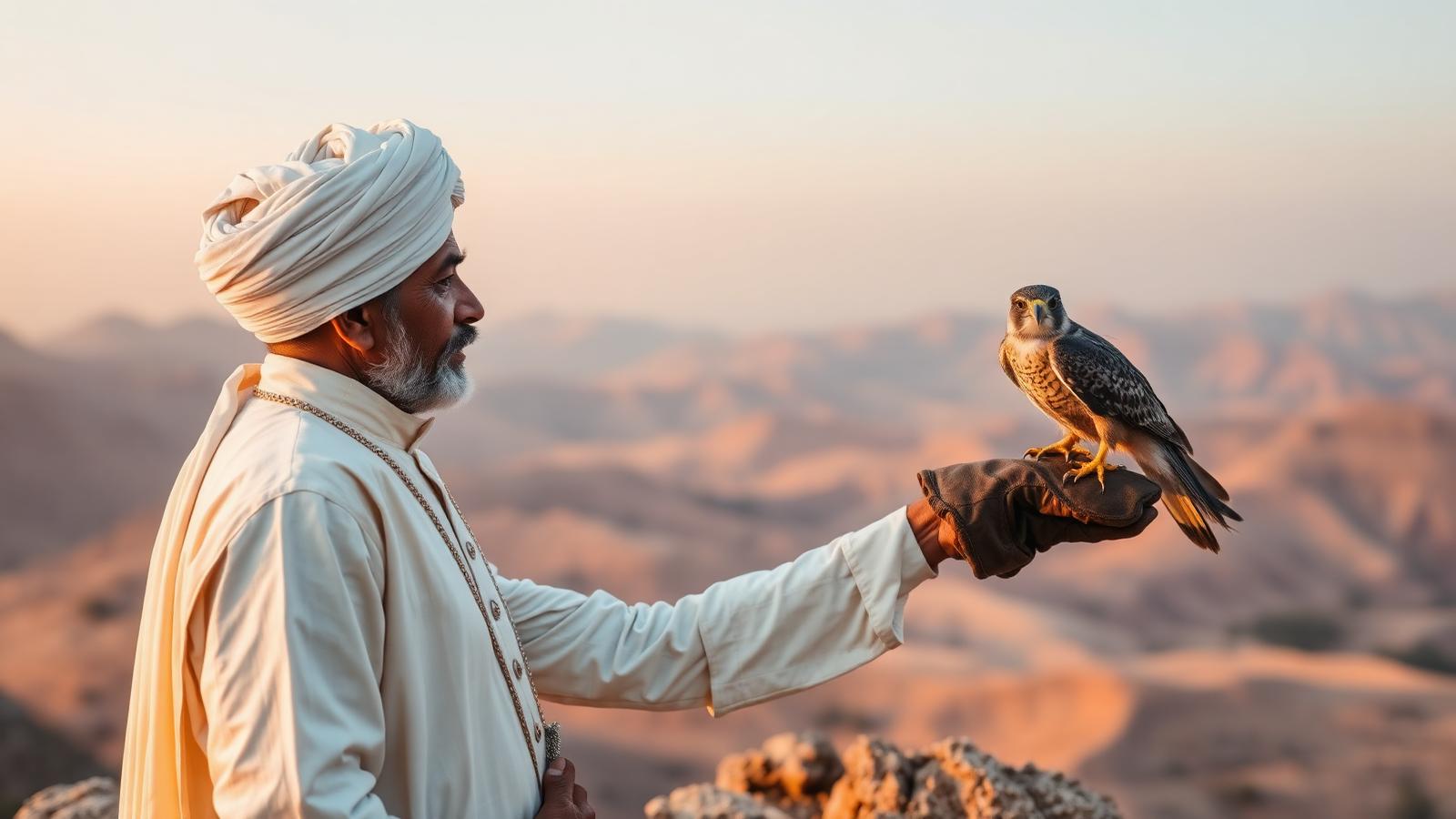
Falconry — shikar with trained birds — was the formal sport of Mewar royalty for six centuries. Every Maharana from Udai Singh to Bhupal Singh kept a mews of trained peregrines and sakers; the royal falconer held a court rank above many ministers. With the abolition of princely privileges in 1971 and the protection of birds of prey under Indian wildlife law, the practice almost vanished.
Three Mewar families have kept it alive. They no longer hunt with the birds — that is illegal — but they continue to breed, train and fly captive-bred peregrines and sakers under the strict permits required by the Wildlife Act. One of these families opens its early-morning training sessions to a small number of private guests, by appointment, on a private ridge outside the city.
A falconer does not own his bird. He keeps an appointment with her every morning, and she chooses, every morning, to keep it back.The House of Udaipurs
The Drive Out at 4:45am
The session is at first light, which means a 4:45am pickup in winter and a 4:30am pickup in summer. A vehicle from the operator collects you from your hotel; the drive to the Aravalli ridge takes about thirty-five minutes, mostly through empty road as the city sleeps.
You arrive while it is still dark. The falconer is already there with the bird, a hooded peregrine on a perch beside a small fire of acacia wood. Coffee or chai is poured. He will not say much in the first ten minutes; this is not rudeness — it is how a falconer speaks to a bird, and you are entering the bird's morning, not the other way around.
The Glove and the Hood
As the first grey appears in the east, the falconer hands you a heavy leather gauntlet. He shows you how to hold it: arm out, elbow bent at ninety degrees, fist relaxed but firm. He explains the bird — her age (usually three to five years), her weight (kept exact, to the gram), her temperament.
Then the hood is removed. The bird looks at you. You will feel, briefly, that you have been measured. You hold the position. After perhaps a minute the falconer takes the bird back and walks her along the ridge, turning her into the rising wind. The east is now amber. Sunrise is two minutes away.
- Duration
- 90 minutes on the ridge; full activity including pickup and return is roughly 3 hours.
- Indicative cost (2026)
- ₹8,500–₹14,000 per person, including private vehicle, falconer, and chai. Two-person minimum.
- Best months
- October to March, when mornings are cool and the birds are most willing to fly the lure.
- What to wear
- Long sleeves, closed shoes, a warm layer for winter mornings. Sunglasses for the second half.
Mewar built half its history on the back of these birds. Three families are the reason it is not yet only history.The House of Udaipurs
The Release
The bird is released as the sun crests the ridge. She climbs in a long spiral, almost lazily, until she is a small dark mark against the gold sky. The falconer whistles once. She turns. He swings the lure — a small leather pad on a string — in a slow circle.
She comes down at full speed. Two hundred metres, maybe three, in a steep direct stoop. She hits the lure exactly. The falconer rewards her with a small piece of meat. She climbs back to his glove. The whole arc lasts perhaps forty seconds.
She will be flown twice more, lower and shorter each time, until the morning thermals get strong enough that flying her becomes an indulgence. By 6:30am the session is over. You sit on the ridge with the falconer and a second cup of chai. The valley below — green at the edges, dust-gold in the centre — is now fully lit. You drive back to Udaipur in time for breakfast at your hotel, with the unusually quiet certainty that almost no other guest in your city has spent the morning quite as you have.