
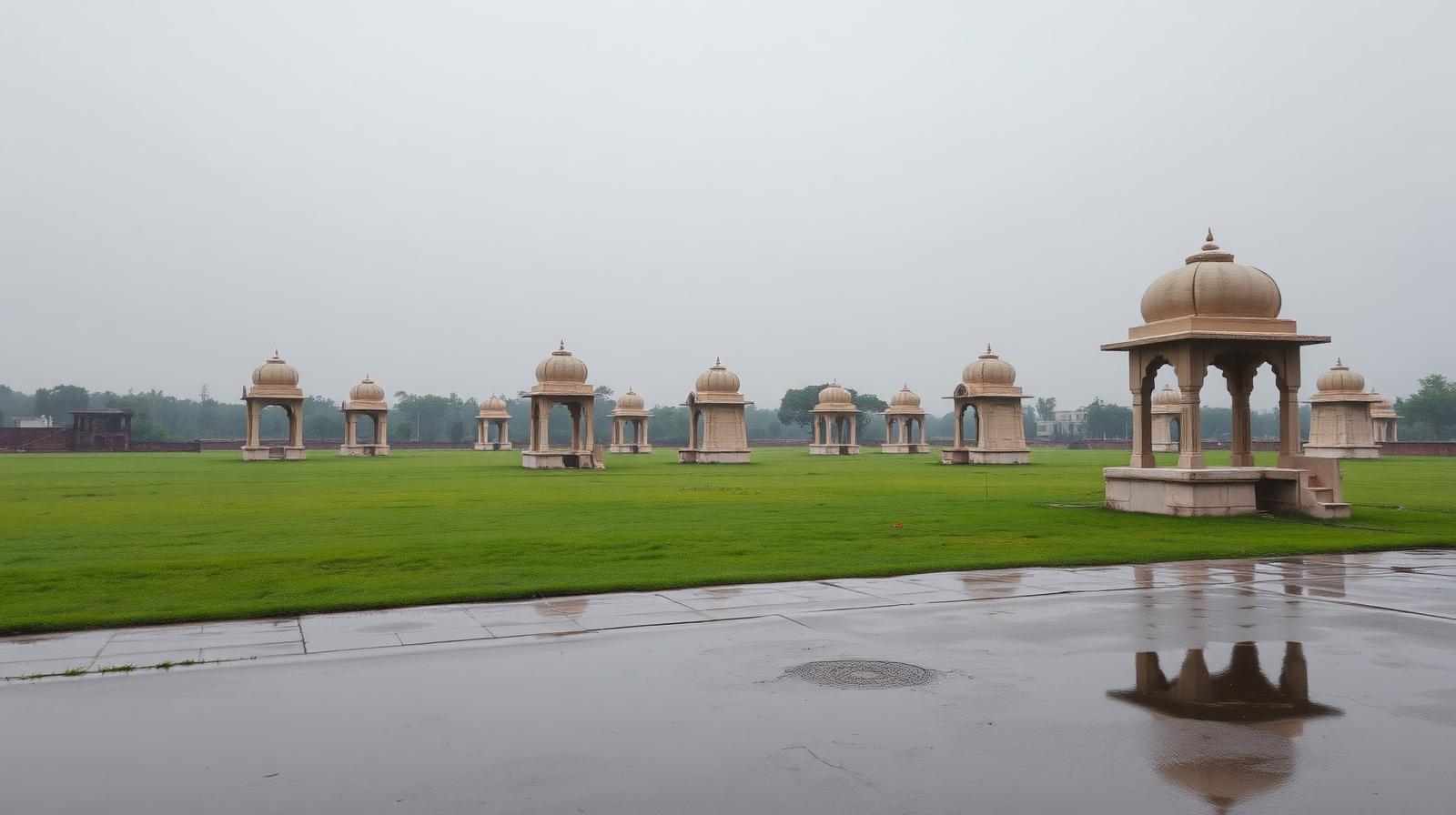
The Quietest Site in Udaipur
Three kilometres east of the City Palace, on a low rise above the Ahar river, sit 372 stone domes. They are the cenotaphs of the Mewar dynasty — chhatris raised over the cremation sites of nineteen Maharanas and their consorts, beginning in the late 16th century and continuing into the early 20th. The site is free, open all day, and on most weekday mornings holds fewer than ten visitors at a time. By Udaipur's standards, this is silence.
The Ahar cenotaphs do not appear on most one-day Udaipur itineraries, and there is a specific reason for this. The site does not photograph well in the bright midday sun that most visitors pass through it in. The chhatris are made of cream and grey sandstone; in flat overhead light, they read as a slightly disorganised cluster of domes, the carvings flattened, the spatial relationships between them indistinct. A visitor who sees Ahar at noon often leaves underwhelmed and recommends Saheliyon-ki-Bari or Sajjangarh instead.
Visit at the right hour, in the right season, and the same site is one of the most extraordinary architectural experiences in Udaipur. The chhatris come alive in raking light — early morning, late afternoon, and especially in the diffuse, cloud-broken light of the post-monsoon weeks when the wet sandstone deepens into a saturated brown-gold and the carvings throw long, defined shadows. The same domes that looked indistinct at noon resolve into a precise, melancholy choreography of memorial architecture.
What you are looking at is not a graveyard. The chhatris are cenotaphs — empty memorials marking the spot where each ruler was cremated and his ashes consigned to the river. There are no remains under them. The structures themselves are a Rajput memorial form: a domed pavilion on twelve, sixteen or twenty-four columns, raised on a high plinth, often with carved images of the deceased on the inner walls. The Mewar tradition specifically organises them in family clusters, so that a single Maharana's chhatri sits at the centre of a constellation of his consorts' smaller domes.
It is a site for slow walking. Two hours minimum. Bring water and a wide-brimmed hat in summer; in winter a light shawl is enough. There is no café on site, no signage in English beyond a single weathered board at the entrance, and no guides at the gate — though the caretakers, if approached respectfully, are often willing to walk a small group through the central clusters for ₹200–500.
The chhatris come alive in raking light, and most alive in the diffuse, cloud-broken light of the post-monsoon weeks.The House of Udaipurs
The Week After Monsoon
The single best window for visiting Ahar is the seven to ten days immediately after the monsoon's first heavy break, typically between late July and early September. The reasons are atmospheric, optical and emotional, and they compound.
Atmospherically, the post-monsoon air in Udaipur is the cleanest it gets all year. The dust that hangs over the city through April, May and June has been washed out of the atmosphere; the haze that returns in late October has not yet built up. Distant ridges that are invisible in March become visible from Ahar's plinths, and the Aravalli silhouette behind the chhatris becomes part of the composition rather than a vague suggestion of one.
Optically, the wet sandstone changes everything. Dry sandstone in the bright winter sun is a flat, almost yellow surface that bleaches out on the camera. Wet sandstone in diffuse post-monsoon light is a deep, saturated brown-gold with visible grain. The carvings — particularly the figural panels on the inner walls of the larger chhatris — become legible in a way they simply are not when the stone is dry. Photographers who shoot Ahar correctly almost always shoot it within 48 hours of rain.
Emotionally, the site has a melancholy that suits cremation grounds, and the melancholy is amplified by monsoon. The river runs full beside the chhatris; the surrounding landscape, browned for nine months of the year, turns a brief, intense green; the chhatris themselves stand in a kind of grave dignity that a dry, sun-bleached visit cannot deliver. This is, frankly, what the architects intended. The chhatris were built to be visited in the rains, when the river ran and the cremation ghats below were active.
The trade-offs are real. Monsoon visits require flexibility — heavy rain shuts the site, the stone underfoot becomes slippery, mosquitoes are constant, and the small museum on the site is sometimes closed. Plan two windows. Carry an umbrella. Wear shoes with grip. The reward, on the right morning, is a site that almost no winter visitor will ever see.
What to Look For in the Carvings
The chhatris reward close looking. Most visitors walk through the central plaza, photograph two or three of the larger domes, and leave inside thirty minutes. The site reveals itself to people who spend two hours here and look at the inner walls.
The figural panels on the inner walls of the largest chhatris — particularly those of Maharana Amar Singh I (d. 1620), Maharana Karan Singh II (d. 1628) and Maharana Sangram Singh II (d. 1734) — are the most artistically significant feature of the site. They typically show the deceased ruler seated in court, sometimes with his consorts, sometimes with his sword and shield arranged before him, and almost always with his horse — a Mewar memorial convention. The carvings are in shallow relief, no more than three or four centimetres deep, and they are most legible in raking light.
Look for the consort panels. When a Maharana's consorts performed sati at his cremation — historically common in this dynasty until the practice was outlawed in the 19th century — they were memorialised on smaller chhatris arranged around his. The inner walls of these consort chhatris show stylised images of the women, often holding a lotus or with hands folded in pranam. The most extensive cluster of consort chhatris is around Maharana Sangram Singh II's central dome — at least seven, possibly nine, depending on how you count the smaller secondary memorials.
Look for the columns. Mewar chhatris use a distinctive column type — a square or octagonal base, a fluted shaft, and a bracketed capital with three or four tiers of carving. The most ornate columns are on the chhatris of the 17th and early 18th century; the columns become simpler and more standardised by the late 18th century, as the dynasty's resources and time for such work declined. Walking the chhatris in chronological order — there is a rough chronological arrangement east to west — is, in effect, a visible timeline of Mewar craft economics.
Look at the dome interiors. The undersides of the largest domes have concentric ring carvings that are almost invisible from the plaza but that resolve from directly underneath. Stand under the centre of a 17th-century chhatri and look up. The geometric inscription is often a circular Sanskrit verse from the Bhagavad Gita or a stylised lotus mandala. These are the moments at which the site stops being architecture and becomes something closer to prayer.
It is a site for slow walking. Two hours minimum. The frames you make in the first thirty minutes will not be the frames you keep.The House of Udaipurs
The Museum Most Visitors Skip
Adjacent to the cenotaphs, in a small whitewashed building most visitors walk straight past, sits the Ahar Government Museum. It is one of the more important small museums in Rajasthan, and is, on any given day, almost empty.
The collection's significance is archaeological rather than royal. Ahar is, in fact, the type-site of the Ahar–Banas culture, a Bronze Age civilisation that occupied the Mewar plain between roughly 3000 and 1500 BCE — earlier than the Vedic period, contemporary with the late Indus Valley. Excavations at the site in the 1950s and 1960s recovered copper tools, painted black-and-red ware, terracotta figurines, and the remains of a settlement that predates Udaipur itself by nearly four thousand years.
The museum holds a small but well-presented selection of these finds — perhaps 150 objects in total — alongside later medieval material from the chhatri site. The labelling is in English and Hindi, the cases are dusty but the objects are real, and the entire visit takes around 25 minutes. Entry is ₹20 for Indians and ₹100 for foreign visitors in 2026 prices. Photography inside is permitted without flash.
What the museum gives the cenotaph visit is depth. The chhatris are 16th-to-20th-century memorials; the museum reminds you that they sit on top of a settlement layer that begins five millennia earlier. Walking out of the museum and back into the chhatri plaza, the site reads differently — as one of the longest continuously occupied ritual sites in north India rather than as an isolated medieval graveyard.
The museum is open 10am to 5pm, closed Fridays. The cenotaphs themselves are open dawn to dusk every day. The combination — chhatris at sunrise, museum at 10am, walk back through the chhatris at 11 — is a half-morning that holds its own against any of Udaipur's headline experiences.
How to Photograph Without Diminishing
Ahar is one of the few Udaipur sites where photography genuinely changes the experience — usually for the worse. The site's quality is its emptiness and its melancholy, and both are easily disrupted by even a small group photographing at the wrong scale.
Shoot wide, not tight. The chhatris work as a constellation rather than as individual portraits. A single dome shot tight in the frame loses what makes the site coherent; a wide composition that includes three or four domes, the plinth steps, and the Aravalli silhouette behind reads correctly. A 24–35mm equivalent lens is the right tool. Long lenses flatten the spatial relationships and produce frames that look like postcards from anywhere.
Avoid drone footage. Drones are not formally banned at the time of writing but are deeply incongruous at the site, and the propeller noise carries half a kilometre. The site is a ritual space; the chhatris are still occasionally visited by descendants of the Mewar family for memorial observances, and the assumption of stillness is not yours to break.
Do not photograph the caretakers without asking. They are often elderly men from the surrounding villages who have worked the site for decades, and they are not part of the spectacle. A respectful approach, a brief chat, and a gentle request for a portrait is almost always welcomed; the alternative is undignified for everyone.
Most importantly, leave the camera in the bag for the first thirty minutes. Walk the central plaza, sit on the steps of one of the larger chhatris, and let the scale of the site organise itself in your head before you start composing. The frames you make after that half-hour will be different — quieter, more spacious, less interested in spectacle. The site rewards this.