
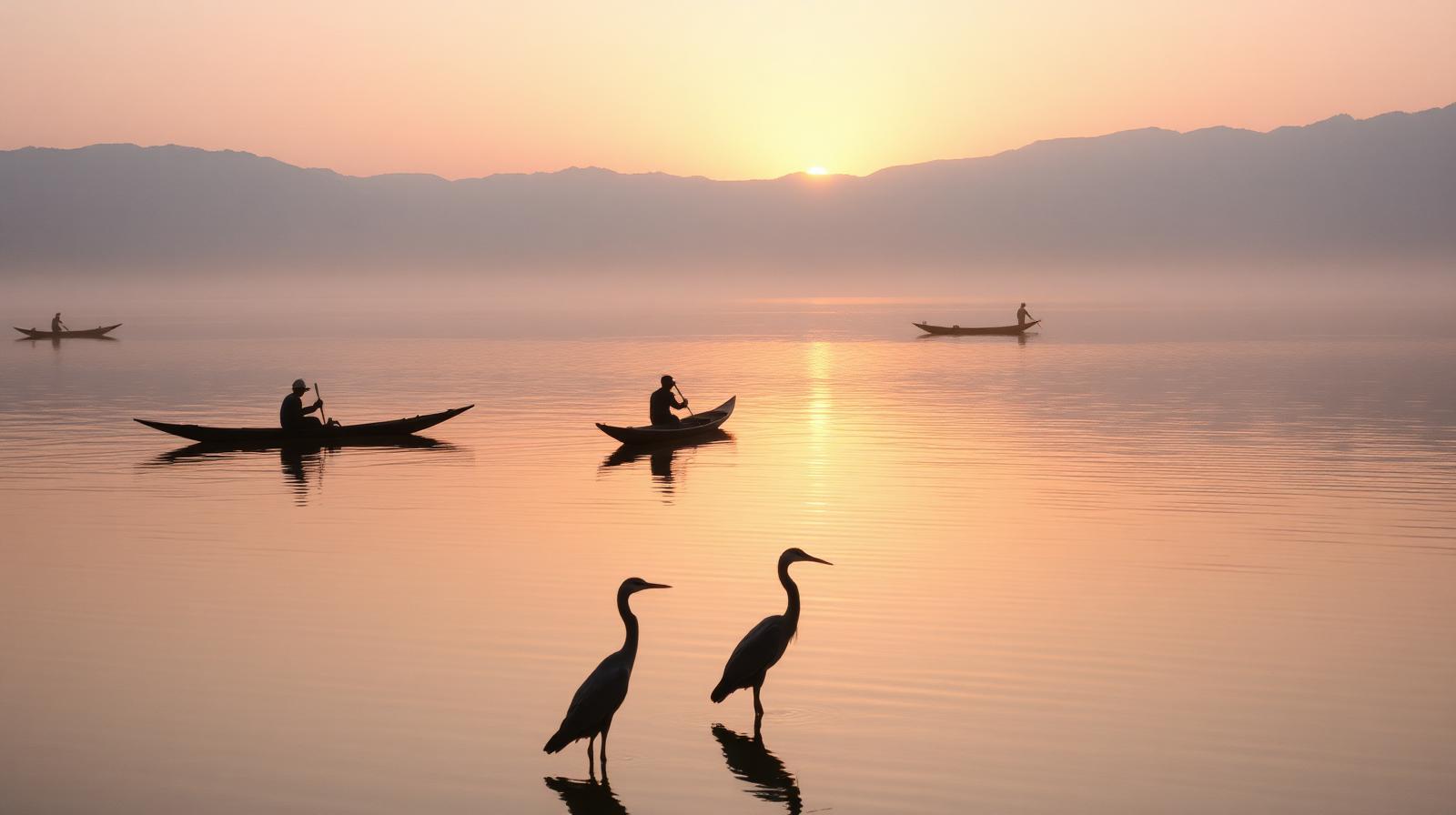
The Lake the City Forgot
Eight kilometres west of Udaipur, on the road to Kumbhalgarh, the Aravallis open into a basin holding a 155-hectare reservoir built in 1652 by Maharana Raj Singh I. This is Badi Lake. It is older than the famine it was built to relieve and quieter than the lakes most visitors come for. At 6am, before the boat operators arrive and before the city's auto-rickshaws have begun their first run westward, Badi Lake is the Udaipur most visitors never see — and most locals already know about.
Pichola has the palaces; Fateh Sagar has the promenade and the ice-cream stalls; Swaroop Sagar has the city wrapped around it. Badi Lake has none of those. It has the Aravallis on three sides, a long causeway on the fourth, fishermen who have worked the same banks for four generations, and a population of grey herons, kingfishers and the occasional purple swamphen that does not appear in any tourist brochure. The lake's emptiness is not an accident. It is the consequence of being slightly inconvenient — twenty minutes by car from the city, no organised waterfront, no formal entry, no ticketing, no crowds.
What Badi Lake gives you, in exchange for the small inconvenience of getting there, is an hour of light most visitors will never photograph. Between roughly 5:45 and 6:45 in the morning — earlier in summer, later in winter — the sun rises over the eastern Aravalli ridge and crosses the lake's surface as a single, low band of orange. The water, untouched by boat propellers at that hour, holds the light unbroken. The fishermen, in their flat wooden coracles, become silhouettes against it. It is the kind of light that makes the rest of Udaipur, however lovely, suddenly feel too curated.
We are deliberately writing this story without naming any specific viewing point. Badi Lake's quality depends on its quietness, and the moment a single bend in the eastern bank gets named, photographed, geotagged and added to a route, it stops being the lake we are describing. What we will say is this: drive out from Udaipur on the road to Kumbhalgarh, and any of the unmarked turn-offs to the south of the highway between Bedla and Kodiyat will bring you to a stretch of bank from which the lake reveals itself slowly. Walk for ten minutes. The right place will be obvious.
Most visitors who do come to Badi Lake come at the wrong hour. They arrive at 11am, find the boat operators waiting, take a thirty-minute ride, and leave underwhelmed. The lake at 11am is a competent but unremarkable reservoir; the lake at 6am is something else entirely. The hour is the whole story.
At 6am, Badi Lake is the Udaipur most visitors never see — and most locals already know about.The House of Udaipurs
The Drive Out at 5:30am
The road from the city to Badi Lake is, in itself, part of the experience. At 5:30 in the morning, Udaipur is quieter than it ever is — the auto-rickshaws have not started, the school traffic is two hours away, and the road that climbs west out of the city through Bedla feels almost private.
From the City Palace area, the drive is around 25 minutes. From Fateh Sagar's western edge, around 18. The road climbs steadily through the suburbs of Saheli Marg and Bedla before opening into the flatter stretch toward Kumbhalgarh. The eastern Aravallis appear on the right as a soft, layered silhouette; if you are driving in November or December, there will often be mist sitting in the valleys at this hour, and the headlights of approaching trucks come at you slowly through it.
We strongly recommend taking a private taxi rather than driving yourself. Two reasons. First, the unmarked turn-offs to the lake are easy to miss in the dark, and a local driver will know which one to take based on where the sun is going to break that morning. Second, parking on the bank is informal at best — there are no marked spaces, and leaving a self-driven car on a dirt shoulder for two hours invites the kind of small chaos that ruins a sunrise. A taxi for three hours, including waiting time, costs around ₹800-1200 in 2026 prices, and is the best money you will spend in Udaipur.
Carry warm clothing in winter. The temperature differential between the city and Badi Lake at 6am in December can be eight to ten degrees — the lake basin holds cold air longer than the city does — and visitors who arrive in light cottons spend the first twenty minutes being too uncomfortable to enjoy the light. A simple shawl or a light fleece is enough. Carry water. There is no kiosk, no chai stall, no shop within walking distance of any of the better viewing stretches.
Leave the city by 5:30am in winter and 5:00am in summer. The light begins to flatten by about 7:00am in summer and 7:30am in winter, and the magic hour is genuinely an hour, not a window. Arriving at 6:45 to a sunrise that began at 6:10 is a frustration this lake does not deserve.
Fishermen, Herons, and the Etiquette of the Bank
Badi Lake is not a wilderness. It is a working lake with a small, intergenerational fishing community that has cast nets here for four generations. The etiquette of the eastern bank at sunrise is the etiquette of being a guest in someone else's morning.
The fishermen begin work between 5:30 and 6:00. They use small flat-bottomed wooden coracles — locally called 'donga' — that hold one or two men and a folded gill net. Most cast within 50 metres of the bank, working a quiet rhythm of throw, wait, retrieve. They are not performing. They are not, in any sense, available for photographs in the way a Pichola boatman might be. They are working, and the morning's catch — typically rohu, catla and the occasional hilsa — is the family's livelihood.
The right way to be present is to stand back, walk slowly, and let your presence be noticed without being announced. Most fishermen will give a brief nod once they have seen you; that is the moment, if you have come with a camera, to lift it. Photograph at a respectful distance. Do not approach the coracles. Do not call out. If you would like a closer image, the right approach is to ask through your driver — many of the regular Udaipur drivers know the fishermen by name — and to offer ₹100-200 for the time, which is the local norm.
The herons, the kingfishers and the occasional purple swamphen do not require permission, but they do require stillness. Grey herons in particular are extraordinarily sensitive to movement at dawn, and a single quick gesture from forty metres away will lift one off the shallows for the rest of the morning. Walk slowly. Stop often. The lake rewards stillness in a way the city does not.
By around 7:30am, the first day-trippers arrive — often weekend Udaipur families bringing breakfast in tiffin boxes — and the lake's register changes. The fishermen pull in. The boats start at 9. The herons relocate to less disturbed corners. This is the moment to leave, ideally with a long, unhurried walk back to the road and a stop at one of the small chai stalls on the highway for a kettle of cardamom tea. The whole experience, from city departure to return, is around three hours.
Pichola at sunrise is a portrait of the city. Badi at sunrise is a portrait of the lake itself.The House of Udaipurs
Why Badi Photographs Differently
Photographers who have shot both Pichola and Badi at sunrise often describe the difference as a difference in what the lake is willing to give back. Pichola at sunrise is a portrait of the city. Badi at sunrise is a portrait of the lake itself.
Pichola's sunrise frames are dominated by the City Palace, the Lake Palace, the ghats, the boats, the lit lamps still burning from the night. The lake is the stage; the city is the subject. It is a famous photograph, repeated thousands of times a year, and it deserves its fame. But it is also a photograph in which the lake itself is almost incidental — a reflective surface for everything else.
Badi has nothing on it. No palace, no city wrap, no marquee architecture. The lake itself is the subject, and the only elements in the frame are the water, the light, the silhouette of the Aravallis, and whatever the lake is producing that morning — a fisherman, a heron, a kingfisher's dive, the long V of a swimming snake at the surface. The frames are quieter, sparer, and far more dependent on the photographer's patience than on the venue's iconicity. Photographers who care about composition love this. Photographers who came for the postcard get bored.
The light is also genuinely different. Because Badi sits in a basin surrounded by ridges on three sides, the sun does not appear at the horizon — it appears already three or four degrees above it, having cleared the eastern ridge — and the resulting light is warmer and lower-angled than at the open lakes in town. The first 25 minutes of light at Badi look, on the camera, like the last 10 minutes of light elsewhere. It is, optically, a longer golden hour.
Mobile-phone photography works fine here. The most beautiful frames we have seen of Badi Lake at dawn were not made on full-frame cameras with long lenses; they were made on iPhones held very still, in landscape orientation, with the horizon line on the lower third and a single fisherman's silhouette as the punctuation. This is a lake that rewards restraint.
How to Leave the Lake the Way You Found It
Badi Lake is fragile in a specific way. Its quality is not protected by ticketing, signage or wardens. It is protected by the fact that very few people come, and that those who come behave well. Both of those facts can change quickly. The honest closing instruction is to leave the lake the way you found it.
Carry your trash out. There are no bins. A small backpack with one ziplock bag for whatever you generate — a water bottle, a tissue, an empty biscuit wrapper — is enough. The fishermen do not have cleanup services, and a single discarded plastic bottle in the shallows will sit there for months.
Do not geotag the specific bend in the bank you found beautiful. We are deliberately not naming it; we would ask the same of you. The most fragile thing about Badi Lake is the unmarked, informal nature of its access, and a single Instagram pin can shift a quiet stretch of bank into a 200-person Sunday traffic jam within a season. If you want to recommend the lake to a friend, recommend the lake by name and let them find their own bend in the bank.
Do not pay anyone to clear the herons for a photograph. This is not, to be clear, a common request — but it has happened. The fishermen will not do it, and the request itself damages the relationship between the visitor and the bank. The herons are the lake. If you want a frame with herons, wait for one. They come back.
And come back yourself. The lake at sunrise in winter (December–February) is a different lake from sunrise in monsoon (July–September) when the basin fills, the surrounding hills turn green, and the bird population doubles. Both are worth the alarm clock. Neither will be on the standard Udaipur itinerary, which is precisely the point of writing about them at all.