
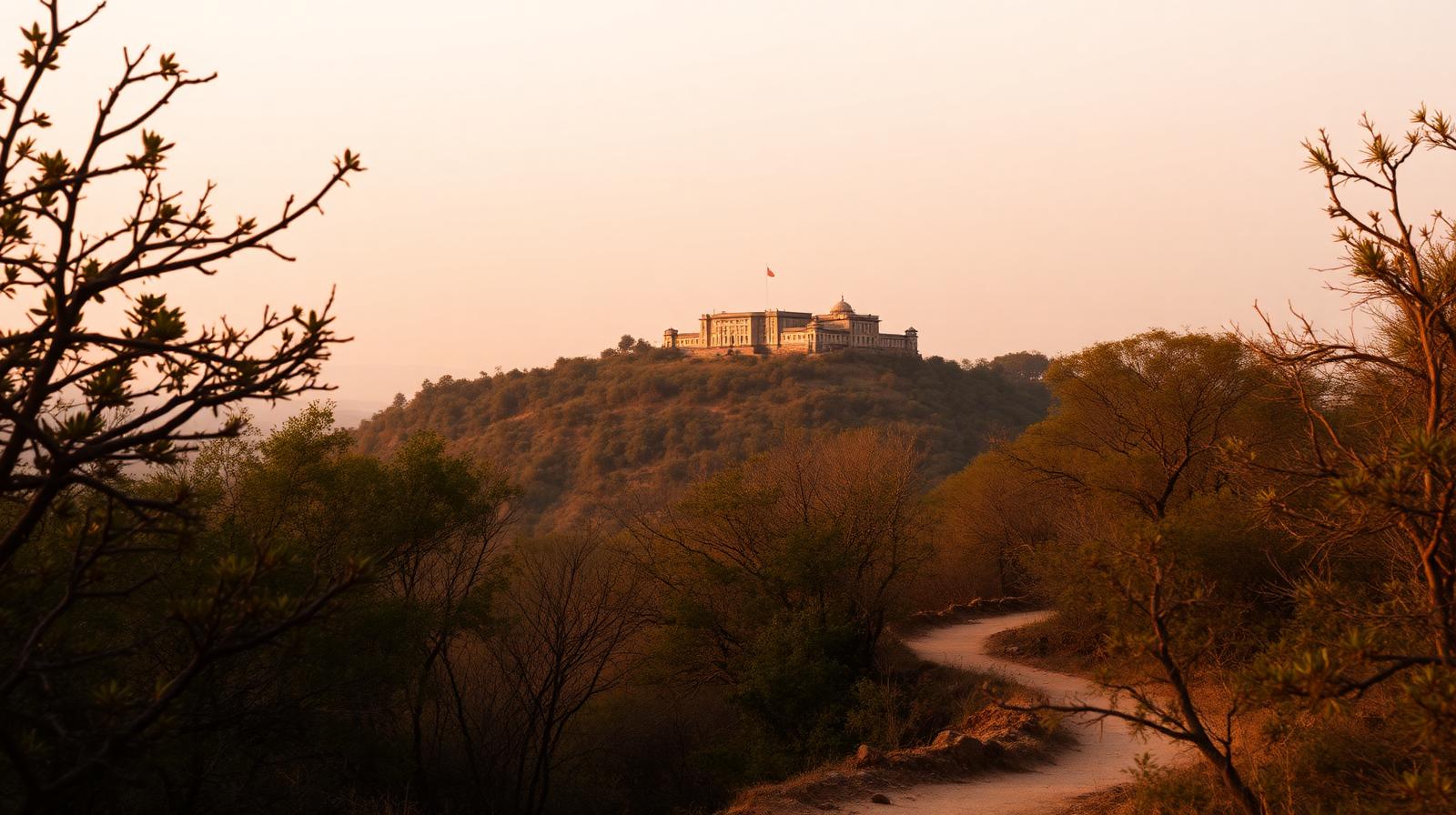
The Road and the Trail
Sajjangarh, built in 1884 by Maharana Sajjan Singh as a high-altitude observatory for monitoring the monsoon clouds rolling in from the Arabian Sea, sits on a 944-metre ridge above the western edge of Udaipur. It is the highest building in the city, and it is one of the best places to watch the sun set over the Aravallis. Almost everyone who visits arrives by jeep on the paved road that switchbacks up from the sanctuary's lower gate. There is another way.
The Sajjangarh Wildlife Sanctuary, which surrounds the palace, has a network of forest trails used primarily by the sanctuary's own staff and by a small number of regular Udaipur walkers. One of these trails — a fairly direct line from the lower gate to the palace ridge, climbing through dry deciduous forest — is open to visitors who pay the standard sanctuary entry. It is around 4 kilometres in length, climbs roughly 380 metres in altitude, and takes a moderately fit walker between 75 and 100 minutes one-way.
It is, frankly, a different visit. The road, taken by jeep, is a twelve-minute switchback that delivers you to the palace plateau without effort, and is appropriate for older visitors, families with small children, or anyone with knee problems. The trail is a slow ascent through forest, with the city dropping away behind you and the air thinning slightly as you climb, and it changes the meaning of arriving at the palace. The view from the upper terrace is the same view; the experience of having earned it is not.
We are not suggesting the trail is for everyone. Visitors with cardiac conditions, mobility issues or asthma should take the road. Visitors travelling in May or June should also take the road; the heat on the south-facing trail in summer afternoons is genuinely dangerous, and even a 7am summer climb requires careful hydration. The right window for the trail is October to March, in the morning, on a clear day.
The other thing the trail gives you, that the road does not, is wildlife. The sanctuary supports a small population of sambar deer, nilgai (the large blue antelope), wild boar, jackals, and at least one resident leopard — sightings of the leopard by visitors are extremely rare but not unheard of. More commonly, the trail produces langurs in the trees, peacocks in the understorey (especially after rain), and a long list of resident and migratory birds. A pair of binoculars and a small bird-ID app turn the climb into a slow naturalist walk.
Walking up, you arrive at the palace already understanding why it was built. Arriving by jeep delivers you without either.The House of Udaipurs
Getting to the Lower Gate
The Sajjangarh Wildlife Sanctuary's lower gate sits at the foot of the ridge, around 6 kilometres west of the City Palace and 2 kilometres before the road begins its switchbacks. This is where the trail starts. Getting there is straightforward, but the timing matters.
From the city, an auto-rickshaw to the lower gate costs ₹250–350 one-way and takes 18–25 minutes depending on traffic. A taxi is ₹500–700. We strongly recommend taking a taxi if you intend to walk back down the road afterwards, so that the same driver can wait for you at the lower gate; the alternative is finding a return auto from a fairly empty road, which can mean a 45-minute wait at midday.
Sanctuary entry is collected at the lower gate. The current rate (2026) is ₹40 for Indian visitors, ₹250 for foreign visitors, plus a vehicle charge if you are driving up the road. Trekking visitors who park or are dropped at the gate pay only the personal entry. The ticket includes the sanctuary, the trail and the palace plateau; the palace itself has a separate entry of ₹120 (Indian) and ₹350 (foreign).
Start times matter for the trail more than for the road. In winter (November–February), 7:30am is the right departure from the lower gate — early enough that the climb is in cool morning light, late enough that the gate is open and the warden is on duty. In the shoulder months (October, March), 7:00am is better. From April to June, 6:30am is the latest sensible start, and the trail is honestly inadvisable in May. The sanctuary closes for general visitors at 6pm and the trail is not lit; aim to be back at the lower gate, or at the palace plateau, well before then.
The warden at the lower gate will brief you briefly on the trail when you buy the ticket; he speaks English, and he is the right person to ask about current trail conditions, recent leopard sightings (almost always to be taken with a pinch of salt), and the small number of trail intersections where it is possible to take the wrong turn. There is no formal map handed out; the trail is single-track and well-trodden, but a screenshot of an online map showing the lower gate and the palace coordinates is a sensible precaution.
The Climb Itself
The trail begins gently, climbing through scrub forest for the first kilometre at a moderate gradient, then steepening through three switchback sections before opening onto the upper plateau within sight of the palace walls. The whole walk is 75–100 minutes for a moderately fit walker; the second half is harder than the first.
The first section, 0–1.2 km, climbs slowly through teak, dhok and the occasional flame-of-the-forest. The trail is wide enough to walk two abreast; the gradient is gentle. This is the section to look for langurs (almost guaranteed) and to watch for peacock movement in the understorey. Stop briefly at the small clearing at around 800 metres in — this is a good spot to look back at the city, which by this point is already 100m below you and visibly receding.
The second section, 1.2–2.4 km, narrows and climbs more steeply. Three short switchbacks gain about 150 metres of altitude. The forest thins; the gradient touches roughly 20% in places. This is the part of the trail that will tell you whether you are properly hydrated. Carry water; drink small amounts often rather than large amounts at rests. The trail is shaded for most of this section, but there are two short open stretches where you will be in direct sun by 9am even in winter.
The third section, 2.4–4 km, is the long shoulder approach to the palace. The gradient eases; the trail traverses the south-eastern flank of the ridge with intermittent views of the city below. By this point the palace is visible above and to the right, growing slowly larger as you walk toward it. The final 400 metres climb a short rocky pitch onto the palace plateau itself; this is the only short section where hands may be useful for balance.
Total elevation gain: around 380 metres. Total time, lower gate to palace plateau, for a moderately fit walker: 75–100 minutes including a 10-minute rest in the middle. Total water required, in winter: 1.5 litres per person; in shoulder months, 2 litres; in summer, 2.5 litres minimum and the trail is genuinely inadvisable from late April to early September.
The Monsoon Palace is not a single building. It is a 660-hectare ecosystem with a small palace at its peak.The House of Udaipurs
What to See at the Top
Sajjangarh is not, in itself, an architectural masterpiece. It is a small, slightly austere Rajput palace built late in the 19th century — the carving is plainer than the older Mewar work, and the building has been only partially restored. The point of being there is the view, and the view is enormous.
From the upper terrace, the entire Lake Pichola basin opens out below you. On a clear day, you can see the City Palace, the Lake Palace, Jagmandir, Fateh Sagar, Swaroop Sagar and — in the haze beyond — the line of the Aravallis stretching south toward Mount Abu. In monsoon, when the surrounding hills turn green and clouds move at eye-level across the city, this is among the most extraordinary panoramas in India. It is the reason Sajjan Singh built the palace where he did.
The interior has a small museum and a walkable circuit of three storeys. The exhibits are modest — a few palanquins, photographs of the Mewar dynasty, some weapons — but the climb to the upper viewing pavilion is worth doing. The pavilion sits at the very crown of the building and offers an unbroken 360-degree view of the Aravalli range. It is easily missed; ask a guard if necessary.
Sunset is, predictably, the most popular hour for road-arrivers. The plateau gets crowded between 5pm and 6pm in winter; if you have walked up in the morning and want to stay for sunset, plan to spend the middle hours at the small canteen on the plateau (basic but adequate — chai, samosas, biscuits, bottled water at slightly inflated prices) or descend to the city and return by jeep in the afternoon. Walking down for sunset is not advisable; the trail is unlit, and dusk on the ridge falls quickly.
Most morning walkers descend by the road, either by walking it (around 45 minutes downhill) or by taking a shared jeep down from the palace plateau (₹60–100 per person, departing roughly every 20 minutes). We recommend the jeep down, frankly, especially for visitors over fifty — the descent on the road is harder on knees than the climb on the trail was, and the saved energy buys you a better afternoon in the city.
Why the Walk Changes the Visit
It would be easy to dismiss this essay as a hiker's preference — the long way to a place most people sensibly take the short way to. We do not think it is that. Walking up to Sajjangarh changes what the visit means, in a way that the road simply cannot.
The Monsoon Palace was built as a place to watch weather. Maharana Sajjan Singh wanted a high vantage point from which the dynasty's astronomers could observe the monsoon clouds approaching from the Arabian Sea, days before they arrived in the city. The palace was, in that sense, less a residence than an observatory — a building whose entire purpose was about altitude and approach. Arriving by jeep delivers you to the building without making you feel either of those things. Walking up, slowly, with the city receding behind you, you arrive at the palace already understanding why it was built.
Walking also gives you the sanctuary. The road is fast; the sanctuary is invisible to the people in the jeeps. On foot, the langurs in the dhok trees, the peacocks erupting suddenly from the understorey, the occasional fresh leopard pugmark in the soft soil after rain — these become part of the visit. Sajjangarh in this version is not a single building; it is a 660-hectare ecosystem with a small palace at its peak. That is the more honest description.
Finally, the climb gives you the city. From the trail at around the halfway point, looking back, Udaipur arranges itself below in a way no postcard frame can replicate. You can see the lakes, the old city's compact mass, the surrounding ridges, the long lines of the Aravallis. The city you have been walking through at street level becomes visible as a system — a lake-fed urbanism wrapped between hills. This is the kind of seeing the road's twelve minutes do not allow.
Take the trail once, even if you have already been to Sajjangarh by road. It is a different palace. It is, in many ways, a better palace. And on the right morning in November, with the air thin and clean and the city laid out below the trail like a model of itself, it is one of the few short walks in the country that genuinely earns the cliché of the journey being the destination.