
Why Udaipur's Stepwells Are Hidden
Rajasthan's most famous stepwells — Chand Baori in Abhaneri, Toorji ka Jhalra in Jodhpur, Raniji ki Baori in Bundi — are large, photogenic, signposted and ticketed. Udaipur has none of those. What Udaipur has are smaller, working community wells embedded inside the old city's residential fabric, most of which are unsigned, almost all of which are unticketed, and none of which appear on the standard guided itinerary.
There is a historical reason for this. Udaipur, unlike Jodhpur or Bundi, was a lake city from the start — Pichola, Fateh Sagar and Swaroop Sagar gave the population a relatively reliable source of surface water. The city's stepwells were therefore built smaller and more functionally than the great showpiece baoris of the desert belt. They were neighbourhood wells, not civic monuments. They served a few hundred households each, supplemented the lake-fed system in the dry months, and were never intended to be processional architecture.
The result is that Udaipur's baoris look almost domestic by comparison. They are usually one or two stories deep — not the seven or eight of the desert wells — and they are tucked into residential lanes rather than placed at city gates. Bagore-ki-Haveli, the obvious 'stepwell-adjacent' monument that visitors do see, is in fact a haveli with a small attached water tank rather than a true stepwell, and it has slightly distorted the city's reputation by suggesting that this is the only baori-style structure on offer.
It is not. Within a 1.2 km radius of Bagore-ki-Haveli, walking the lanes between Hathi Pol, the Ghantaghar clock tower and the Jagdish Temple, a patient visitor can find at least five surviving stepwells, four of them still in active community use. None of them are signposted. None of them have entry tickets. Two of them are gated and require asking the nearest household to unlock. All of them reward the walk.
We are going to describe what to look for rather than name the five wells precisely. This is the same instinct as the Badi Lake essay: the moment a working community well becomes a tagged Instagram pin, its character changes. What follows is a field guide to noticing, not a checklist.
A baori is not a well with stairs. It is a water-engineering response to a specific climate problem.The House of Udaipurs
How to Read a Baori
Before going looking for them, it is worth understanding what you are looking at. A baori is not a well with stairs. It is a water-engineering response to a specific climate problem, and reading it as architecture changes the experience entirely.
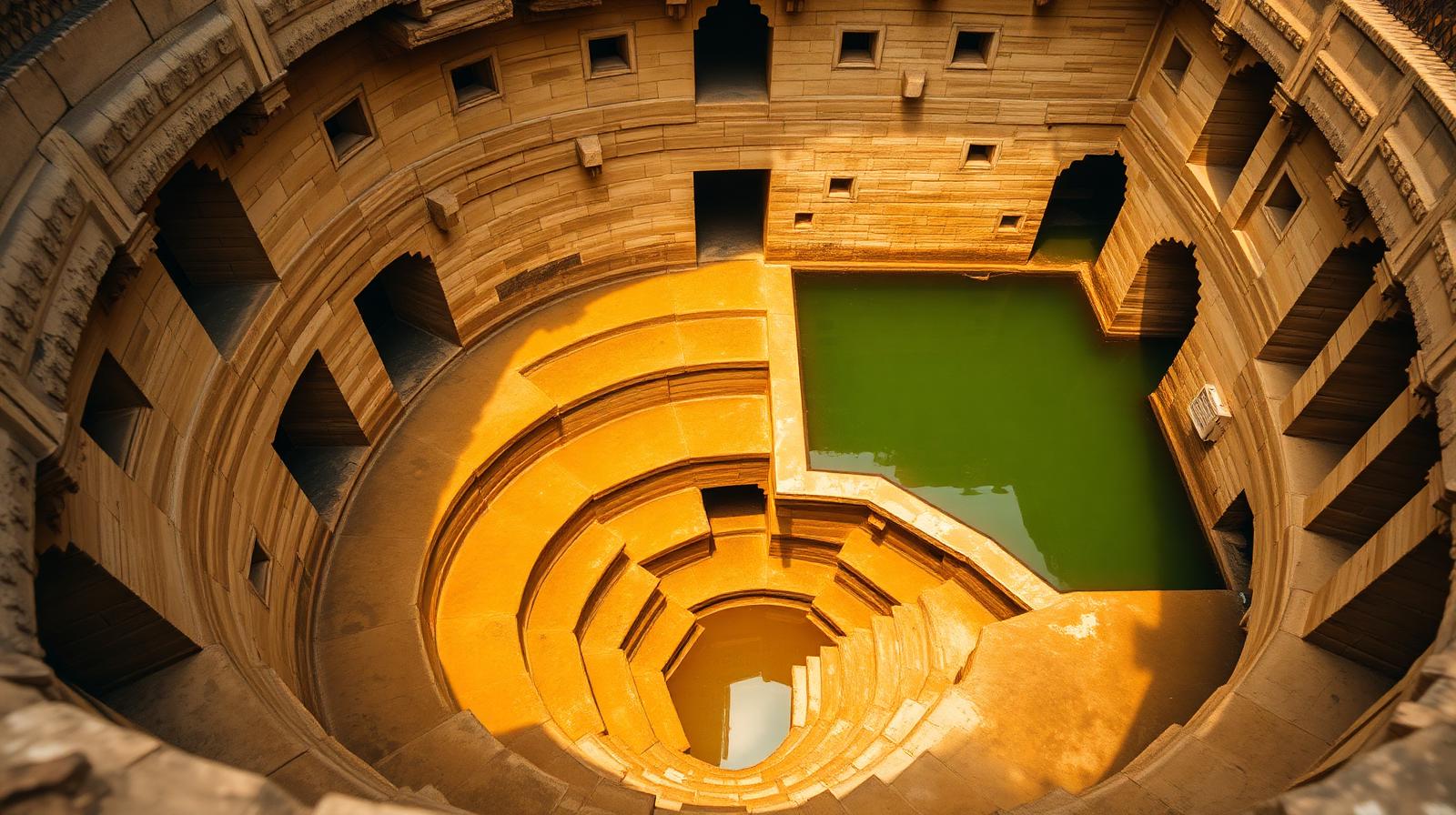
The basic problem the baori solves is this. In Rajasthan, the water table sits 8–18 metres below ground level, depending on season, and the surface is too hot for unshaded water to remain potable in summer. A baori brings the entire population down to the water rather than bringing the water up to the population. The descent — typically a series of stepped landings — keeps the water cool, shaded and accessible without machinery. The deeper landings widen as they descend, creating shaded ledges where women historically waited out the hottest hours of the day.
There are four elements to look for in any Udaipur baori. First, the orientation: most are aligned north-south, so the water level remains shaded for the longest possible portion of the day. Second, the pavilions: the small carved structures at the upper edges, often with intricate brackets, were not decorative — they were the meeting and resting points for the women who collected water before sunrise. Third, the water-level markings: faint horizontal grooves on the descending walls record monsoon high-water and dry-season low-water levels, sometimes for centuries. Fourth, the niches: small rectangular cavities at intervals along the descent held oil lamps for early-morning use.
The stonework matters. Mewar baoris are almost always built from the local cream sandstone — softer than the pink stone of Jaipur, with a finer grain that takes intricate carving but weathers more visibly. A 17th-century Udaipur baori looks visibly older than a 17th-century Jaipur baori for this reason; the surface tells the time more honestly. This is one of the small pleasures of looking at them carefully.
The carvings, where they exist, are usually concentrated on the upper rim and the entry pavilions rather than on the descent itself. The reason is functional: ornate carving on the descending walls would catch and hold water, accelerating erosion. The wall surfaces facing the water are deliberately plain. Ornament respects function in these wells in a way that Western visitors, expecting baroque exuberance throughout, sometimes miss.
The Five Wells, Sketched
Without naming exact lanes, here is what to look for in the five baoris of the old city. Each has a distinct personality, and a 90-minute walk on foot can include three of them comfortably.
The first is a small, two-storey baori inside a residential courtyard near Hathi Pol, still in daily use by the surrounding eight or nine households. The descent is narrow, the water level visible only from the second landing, and the carvings on the upper pavilion are unusually fine — three peacocks worked into a single capital. Access is by asking, politely, at the nearest open door. The standard offering is a small donation of ₹50–100 to the household; many will refuse, but it is the gesture that matters.
The second is a larger, three-storey baori in the lanes behind the Ghantaghar, partially covered by later residential construction so that the upper rim is now indistinguishable from a regular wall. You will recognise it from the iron grate set into a flagstone in the lane — peer through and you can see the water two storeys below. This well is gated and inactive but the descent is intact; finding the family with the key takes some asking.
The third is, in some ways, the most photographed of the five — though only by a small number of visitors who have happened upon it. It sits in an open courtyard near a temple in the eastern quarter of the old city and is half a baori, half a tank: the descent is on one side, the open water surface on the other, with broad steps between them. At 7am in winter, with the morning light falling diagonally across the descent, this is the most architecturally satisfying of the five. We have not named it because the small number of visitors who find it has, so far, kept its character intact.
The fourth and fifth are smaller, simpler, more clearly working wells — used daily for clothes washing and for ritual purposes by the surrounding households. They are not architecturally remarkable in the way the first three are, but they are the closest thing to a 17th-century working baori the city still has. Stand for ten minutes in the early morning and you will see exactly what a baori was for. This is, arguably, more valuable than any photograph.
The descent is not a metaphor. It is the way water gets to a house in summer.The House of Udaipurs
When to Visit, How to Behave
Udaipur's baoris are not museums. They are working pieces of residential infrastructure, embedded in lanes that the same families have lived in for generations. The etiquette of visiting is the etiquette of being a guest in someone's neighbourhood.
The right hour is between 7 and 9 in the morning. The light is correct for the descents, the working wells are most active at this hour, and the residents are awake and hospitable rather than asleep or busy. Visiting between 11 and 4 is uncomfortable for everyone — the stone gets hot, the residents are inside, the water is in shadow only at the deepest level, and the experience flattens.
Dress modestly. Long trousers or a long skirt; shoulders covered. This is not a religious requirement; it is a respect-for-the-neighbourhood requirement, and it changes the conversation when you arrive at a household to ask if you may descend.
Do not descend without asking. Even the unsignposted, gateless wells sit inside someone's lane, often inside their courtyard. The right protocol is to find the nearest open doorway, greet whoever is there with a quiet 'Namaste — kya hum baori dekh sakte hain?' (May we see the baori?), and wait. Permission, in our experience, is given more often than not, and is sometimes accompanied by a cup of chai.
Do not photograph the residents without asking, and do not photograph anyone using the well — particularly the women who collect water in the early morning. The well is theirs; the descent is what you are visiting. A small donation to the local temple or to the household that gave permission, ₹100–200, is the right gesture. Cash, not visible payment apps, please.
Why Stepwells Still Matter
It would be possible to read this essay as a piece of nostalgia — old wells, faded function, residual charm. We do not see them that way. Udaipur's surviving baoris are still, in a quiet way, doing the work they were built for, and that is precisely what makes them worth visiting.
Three of the five wells we have described are in active use today. The water from them is used for washing, for ritual purposes, for the small vegetable plots that still exist in the old city's interior courtyards. They are not relics. They are infrastructure that has continued working for between 250 and 400 years, with very little maintenance, in a climate that breaks most engineering inside a century.
This is the lesson the baori teaches that no monument-stepwell can. A great showpiece baori like Chand Baori is, frankly, easier to read because it has been emptied of function — it is now pure architecture, a beautiful geometric exercise visitors can walk through without negotiating any actual community. Udaipur's wells are the opposite: smaller, less spectacular, but still doing the thing they were built to do. The descent is not a metaphor. It is the way water gets to a house in summer.
There is also, for visitors interested in climate and water-resilience, a quiet contemporary relevance. Rajasthan's water table has fallen sharply in the last fifty years, and many of the great desert baoris are now dry. Udaipur's lake-fed system has insulated its small old-city wells from the worst of this, and they are now among the few remaining baoris in the state still holding water year-round. They are, in that sense, a working laboratory for what pre-industrial water engineering can still teach a city in 2026.
Walk to two of them on a quiet morning. Sit at the upper rim of one for fifteen minutes. The city you have been visiting, the one made of palaces and lakes and ghats, has another city underneath it, four centuries old, still working. That second city is the one this essay is for.