
The Smallest Lake
Doodh Talai means 'milk pond' — a name attributed variously to the lake's whitish appearance after rain, to a 17th-century myth involving the milk of a sacred cow, and to a more prosaic story about a 19th-century dairy that operated on its banks. Whatever the origin, the lake is small: 14 acres of water at the foot of Machla Magra hill, immediately south of the City Palace and west of the much larger Pichola complex. Most visitors walk past it without realising it is a separate lake.
Doodh Talai sits in a kind of geographical seam in Udaipur — between the old city to the north, the City Palace to the east, the Machla Magra ridge to the south, and Pichola's southern bay just beyond. The lake has its own small embankment, its own walking promenade (the Manikya Lal Verma Garden), and a slightly municipal, slightly forgotten feeling. It is the lake the locals walk around in the evening, less the lake the visitors photograph.
Three things sit on its banks. The first is the small, unremarkable Manikya Lal Verma Garden, useful as a walking circuit and not much else. The second is the Doodh Talai Musical Garden — a public park with a fountain show in the evenings that we are about to recommend you skip entirely. The third is the lower terminal of the Karni Mata ropeway, the 387-metre cable car that climbs Machla Magra hill to the small Karni Mata temple at its summit. The ropeway is the reason this essay exists.
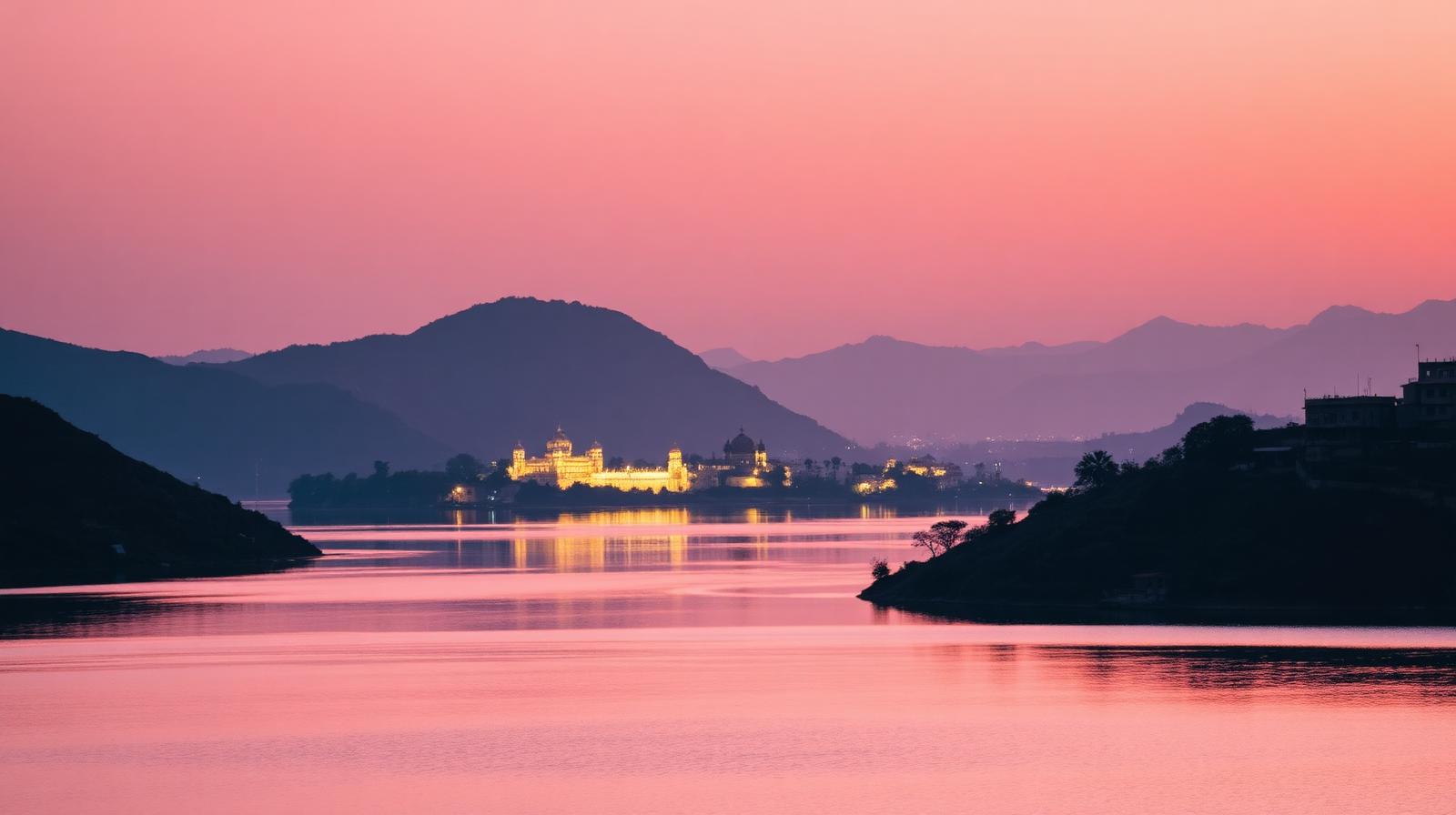
From the temple plateau at the top of the ropeway, the view is geographically unique in Udaipur. You are 80 metres above lake level, looking north and west, with the entire Pichola basin spread out in front of you — the City Palace immediately to the right, the Lake Palace floating in the middle distance, Jagmandir further west, the old city wrapped along the eastern shore, and the Aravallis closing the western horizon. This is the only viewpoint in the city that gives you all of these in a single frame, at eye level rather than from above.
Most importantly, the plateau is small, the ropeway is the only access, and the crowd self-limits. At sunset on a Tuesday in November, you might share the viewing platform with thirty or forty people. By Udaipur's high-season standards, this is empty. The famous sunset spots — the Sajjangarh plateau, Ambrai Ghat — get four to five times that traffic at the same hour.
The smallest lake in Udaipur holds the widest sunset — and the five-minute ropeway up Machla Magra is the quietest way to find it.The House of Udaipurs
The Ropeway, Honestly Described
Let us be honest about what the Karni Mata ropeway actually is. It is a 387-metre, six-cabin Doppelmayr-style cable car installed in 2008, with a vertical rise of around 80 metres, a one-way travel time of five minutes, and a capacity of around 1,000 visitors per hour. It is not a Swiss Alpine cable car. It is a competently maintained Indian municipal ropeway, and it does its job well.
The cabins seat four adults each, are enclosed with sliding glass doors, and are supervised by a single attendant at each terminal. Operations are continuous from 9am to 9pm in season. The fare in 2026 is ₹120 round-trip for adults and ₹70 for children under twelve. There is no online booking; tickets are bought at the lower terminal counter, and the queue at sunset hours can be 15–25 minutes. Arriving 45 minutes before sunset gives you a comfortable buffer; arriving 20 minutes before risks missing the light.
The five-minute ride itself is the kind of low-grade pleasure most visitors enjoy more than they expect to. The cabin lifts smoothly off the lower platform, swings out over the eastern shore of Doodh Talai with the lake immediately below, climbs through the wooded slopes of Machla Magra, and arrives at the upper platform with a small, well-engineered shudder. There is no commentary; the windows open partway for photographs; and the views begin to open out in the second half of the climb.
The descent in the same cabin is, frankly, less interesting — by sunset the city is in shadow and the photographs less rewarding. We strongly recommend taking the ropeway up and walking down on foot. The walking trail descends Machla Magra from a small gate on the eastern side of the temple plateau, takes around 25 minutes, passes through a short stretch of dry forest, and ends near the Doodh Talai bus stand from where you can walk back to the City Palace area in another ten minutes. The whole evening — ropeway up, sunset on the plateau, walk down — takes around 90 minutes from start to finish.
The ropeway is occasionally closed for maintenance, particularly during the monsoon weeks of July and August, and during high winds. Check at the City Palace ticket counter or by phone before making the trip; the official phone number is on the cars themselves and on signage at the lower terminal. We have arrived twice to find the ropeway closed for a half-day inspection; on both occasions the staff were apologetic and the closure was real, not commercial.
What to See from the Plateau
The Karni Mata temple plateau is small — perhaps 1,200 square metres of paved area around the temple itself — and it is the view, not the temple, that most visitors come for. The temple is modest, dedicated to Karni Mata (the 14th-century mystic also venerated at Deshnok), and is worth a brief, respectful visit before walking to the viewing edge.
The viewing edge runs along the northern and western flanks of the plateau, with iron railings, a few benches, and a small kiosk selling chai and snacks. Stand at the north-western corner and the view organises itself: the City Palace immediately below and to the right, its long ochre wall running north along the eastern shore of Pichola; the Lake Palace floating about a kilometre out in the lake's central basin; Jagmandir further west; the old city's compact mass beyond the City Palace; and the long Aravalli ridge closing the horizon to the west and south. On a clear day you can see all of these in a single frame.
The light is the show. As the sun drops toward the western Aravallis, the City Palace's wall transitions from ochre to gold to a deep, saturated orange-brown; the lake reflects the change directly back at you; the Lake Palace lights its first lamps around fifteen minutes before sunset and becomes a small white jewel on a darkening lake; and the old city, which has been a mass of indistinct rooftops, begins to pick itself out in tiny squares of yellow window-light as the dusk gathers. The whole transition takes around 35 minutes from the moment you arrive on the plateau to the moment full darkness falls.
Do not stand still. The plateau is small enough that the view changes meaningfully when you move twenty metres along the railing. The northern edge gives you the City Palace as the dominant element; the north-western edge gives you the Lake Palace centred in the frame; the western edge — slightly less popular — gives you the most uninterrupted Aravalli ridge composition. Walk the edges slowly across the 35 minutes, and you will have three quite different photographs from a single sunset.
Bring a light layer in winter. The plateau gets cold quickly once the sun has dropped — the temperature can fall four or five degrees in fifteen minutes — and visitors in light cottons are often visibly uncomfortable for the most beautiful part of the show. A shawl, a fleece, or a light jacket is enough.
It is not a tourist installation that locals avoid; it is a working civic amenity that the city's residents treat as theirs.The House of Udaipurs
What to Skip at the Bottom
The Doodh Talai Musical Garden, at the lake's eastern edge, runs an evening fountain-and-light show with recorded music. It is heavily marketed in Udaipur tourist literature, included in most hotel-suggested itineraries, and on a typical evening attracts several hundred visitors. We respectfully recommend you skip it entirely.
The show is around 25 minutes long, runs at 7pm and 8pm in season, costs ₹50 per person, and consists of choreographed water jets illuminated by coloured lights, accompanied by a soundtrack of Hindi film music. It is competent, family-friendly, and entirely uninteresting in any aesthetic sense. Visitors arriving in Udaipur with limited time who attend this show in place of something else are, in our honest opinion, making a poor swap.
The opportunity cost is significant. The same hour, spent at Ambrai Ghat watching the City Palace's reflections in Pichola, or at the Karni Mata plateau watching the light cross the western Aravallis, or even just walking the eastern shore of Pichola from Lal Ghat to Bagore-ki-Haveli with chai stops — any of these is a more representative Udaipur evening than the musical garden. The garden is what the city offers when it has nothing more interesting to suggest. The city, as the rest of this series argues, almost always has something more interesting to suggest.
If you have children who will not survive a quiet sunset, the calculation changes; the show is engaging for under-tens for about fifteen minutes, and the surrounding garden is a safe space for them to walk around. For adult visitors, or families with older children, the show is a polite mistake.
The same applies, more gently, to the small boat rides offered on Doodh Talai itself — short pedal-boat circuits of the small lake. These are pleasant for a family with small children but offer nothing a visitor would not get more powerfully on a Pichola boat for a comparable price.
Why Locals Still Use It
The Karni Mata ropeway has a quiet local following that most visitors do not notice. On weekday evenings, particularly between October and February, you will see Udaipur families taking the cable car up — grandparents, parents, small children — for an hour of cool air, a temple visit, a chai on the plateau, and the long walk back down. This is a local evening out, not a tourist attraction.
The reasons are practical. The ropeway is cheap (₹120 round-trip per adult), close to the city centre (10 minutes by auto-rickshaw from the old city), reliably timed (continuous operation), and offers a view that no other affordable Udaipur outing matches. For a family with elderly parents who cannot manage the Sajjangarh climb, and for parents with young children who cannot sit through a long boat ride, the Karni Mata ropeway is a perfect 90-minute evening unit.
There is also a religious dimension that visitors should respect. The temple at the top is an active pilgrimage site, particularly on Tuesdays and during the Navratri festival in autumn, and on those evenings the plateau crowds significantly. If you are not comfortable in a religious crowd, avoid Tuesday and Navratri evenings; choose a Wednesday or Thursday in November for the quietest experience. Behave respectfully near the temple — remove shoes if entering, do not photograph inside the sanctum, do not talk loudly within a few metres of the doorway.
The locals' evening out is, in fact, the recommendation. This is what makes the Karni Mata ropeway interesting. It is not a tourist installation that locals avoid; it is a working civic amenity that the city's residents treat as theirs. Visitors who go up at 5:45 on a Wednesday in November and pay attention to the people around them on the plateau will see Udaipur not as a museum but as a city that still uses its public spaces in roughly the way they were intended.
Walk down. Take the trail rather than the cabin on the way back. Stop at the small chai stall at the base of Machla Magra near the lower terminal. Order one cup, drink it slowly, watch the lights come on across Pichola, and walk the ten minutes back to the old city. This is the evening Udaipur was built for. The musical garden is two minutes away on the same lake. We promise you will not miss it.