
The Dish Mewar Agrees On
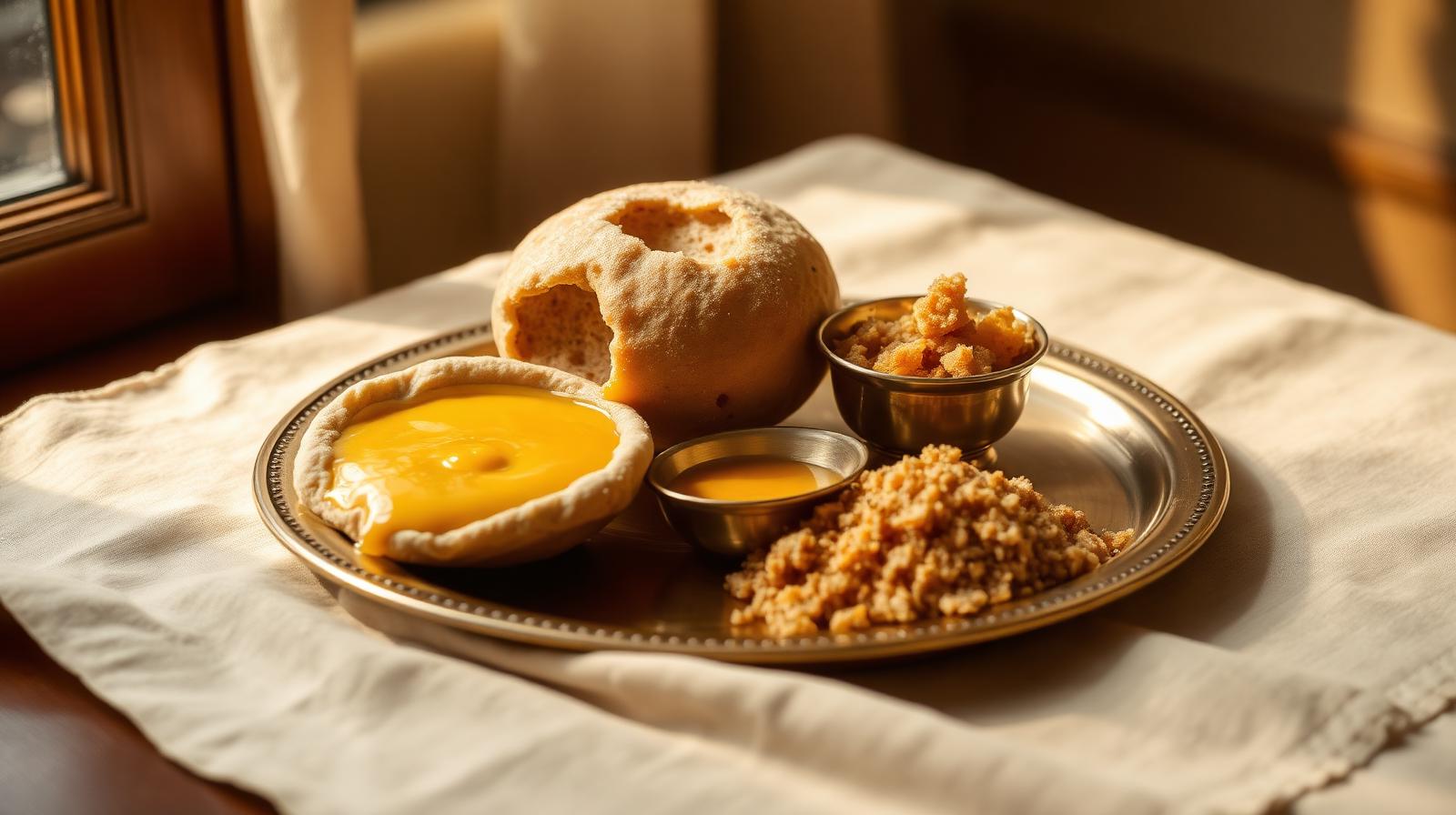
Walk into twenty Udaipur households on a Sunday afternoon and you will find the same trinity on the table — a small pile of split-open wheat baati, a brass katori of yellow lentils, a mound of crumbled churma sweetened with jaggery and laced with cardamom. This is dal-baati-churma. It is the dish Mewar agrees on. It is also the dish Mewar quietly disagrees on, household by household, in ways that matter.
No restaurant plate of dal-baati-churma in Udaipur tastes quite like a household plate. The reason is not technique; the technique is widely shared. The reason is that the dish is built from three components that each absorb the cook’s preferences, and over four or five generations a household develops a fingerprint — a particular dal tempering, a particular baati crumb, a particular churma sweetness — that no menu can replicate.
This story is the result of sitting at twenty kitchen tables across the Old City, Bedla, Sajjangarh and Hiran Magri over six months, eating the same dish twenty times and asking the same three questions: what flour, what tempering, what sweetener. The answers are quieter than you’d expect. They are also the entire reason this dish has lasted six hundred years.
In Mewar, the recipe is not on paper. It is in the wrist of whoever is cooking that day.The House of Udaipurs
The Dal: Where the Tempering Lives
The dal in dal-baati-churma is, by convention, a panchmel — five lentils, soaked overnight, pressure-cooked together with turmeric, cooked down to a soft pourable consistency, then finished with a tempering of ghee, asafoetida, cumin, dried red chilli, and a small handful of garlic and ginger. That is the standard. From there, every household begins to disagree.
Some Mewari Brahmin households use no garlic at all and lean on extra asafoetida; some Marwari trader households add a small spoon of jaggery to the dal itself, which sounds eccentric but produces the gentle round sweetness that surprises every first-time visitor. A working-class household in Hathi Pol I sat with finishes the tempering with a final ghee-fried curry leaf, which is technically South Indian — they picked it up from a Tamil neighbour in the 1980s and never looked back.
The proportions of the five lentils also shift. Toor and chana are universal; moong, urad and masoor enter in different ratios depending on what is in the household’s grain bin. Older homes cook a thicker, almost sambar-like dal; newer homes cook a thinner, more pourable one to mix easily into the baati.
The Baati: Older Than the Recipe
The baati itself is the most stable component of the trinity. Whole-wheat flour (atta), a generous spoon of ghee, a pinch of salt, water, kneaded firm — rolled into balls, slow-baked in coal embers, broken open with the heel of the hand, dunked in ghee. The recipe has not changed in any meaningful way since it was carried out of the Thar Desert eight hundred years ago. What changes is the oven.
Some households still maintain a traditional cow-dung-cake fire in the back courtyard, which gives the baati a distinct smoke note that no gas tandoor reproduces. Others have moved to a small electric tandoor that sits on the kitchen counter; the baati is more uniform, less smoky, equally honest. A handful of younger Bedla households now bake in a domestic convection oven at 220°C for 25 minutes, which produces a baati that is, controversially, perfectly fine.
The quiet rule of every Mewari kitchen is that the baati does not change because the baati does not need to. Everything around it does. The baati is the constant against which the household’s dal and churma reveal themselves.
- Time to bake a single baati
- 20–28 minutes in coal embers; 22–25 minutes in a tandoor; 25 minutes in a domestic oven at 220°C.
- Ghee per baati
- ½ to 1 full tablespoon, depending on the household. Older households are noticeably more generous.
- A full home meal for four
- ~₹350–500 in raw ingredients; ~₹600–900 at a casual Udaipur restaurant; ~₹1,400–2,200 at a heritage hotel.
The baati does not change. The baati does not need to. Everything around it does.The House of Udaipurs
The Churma: Where Households Differ Most
The churma is the trinity’s sweet — leftover or extra baati, crumbled by hand or in a stone mortar, mixed with ghee, jaggery or sugar, and finished with cardamom, sometimes with a scattering of crushed almonds and pistachios. It is also the part of the dish where households differ most loudly, because the sweetness, the texture and the inclusions are entirely a matter of taste.
A traditional Mewari household uses jaggery only — never sugar — and grinds the cardamom fresh in a small brass mortar. Some Marwari households use a 60:40 jaggery-sugar mix and add a small spoon of ghee-toasted gram flour for body. A handful of younger households now finish the churma with a scrape of fresh nutmeg, which is delicious but, depending on whose grandmother you ask, either a thoughtful modernisation or an outright provocation.
The dish ends with the right hand reaching first for a piece of baati, dunking it in dal, then alternating with a small fingerful of churma — savoury, savoury, sweet, in a slow rhythm that empties the plate over forty unhurried minutes. The trinity is designed to be eaten this way. Eaten any other way, it stops being the trinity.
Where to Eat It in Udaipur
A household plate of dal-baati-churma is hard to come by as a visitor — Mewari hospitality is real, but the specific Sunday-afternoon plate is family time. A few options come close.
For a faithful, unfussy plate close to a household version, the small thali joints around Bapu Bazaar — Natraj, Santosh, the older corner of Krishna Bhojnalaya — serve dal-baati-churma in their fixed thali for around ₹250–350 in 2026 prices. The portions are generous; the second helping is free; the dal is good; the baati is honest; the churma is sweetened slightly more than a household version.
For a heritage-hotel version, both Trident and Leela do credible plates, somewhere between ₹1,400 and ₹2,200, with the inevitable presentation upgrades — the baati on a wooden board, the dal in a copper kadhai, the churma shaped into a quenelle. The ingredients are excellent; the soul is necessarily a hotel’s soul, not a household’s. Both versions are worth eating. Neither is a substitute for the other.