
Not As Old As You Think
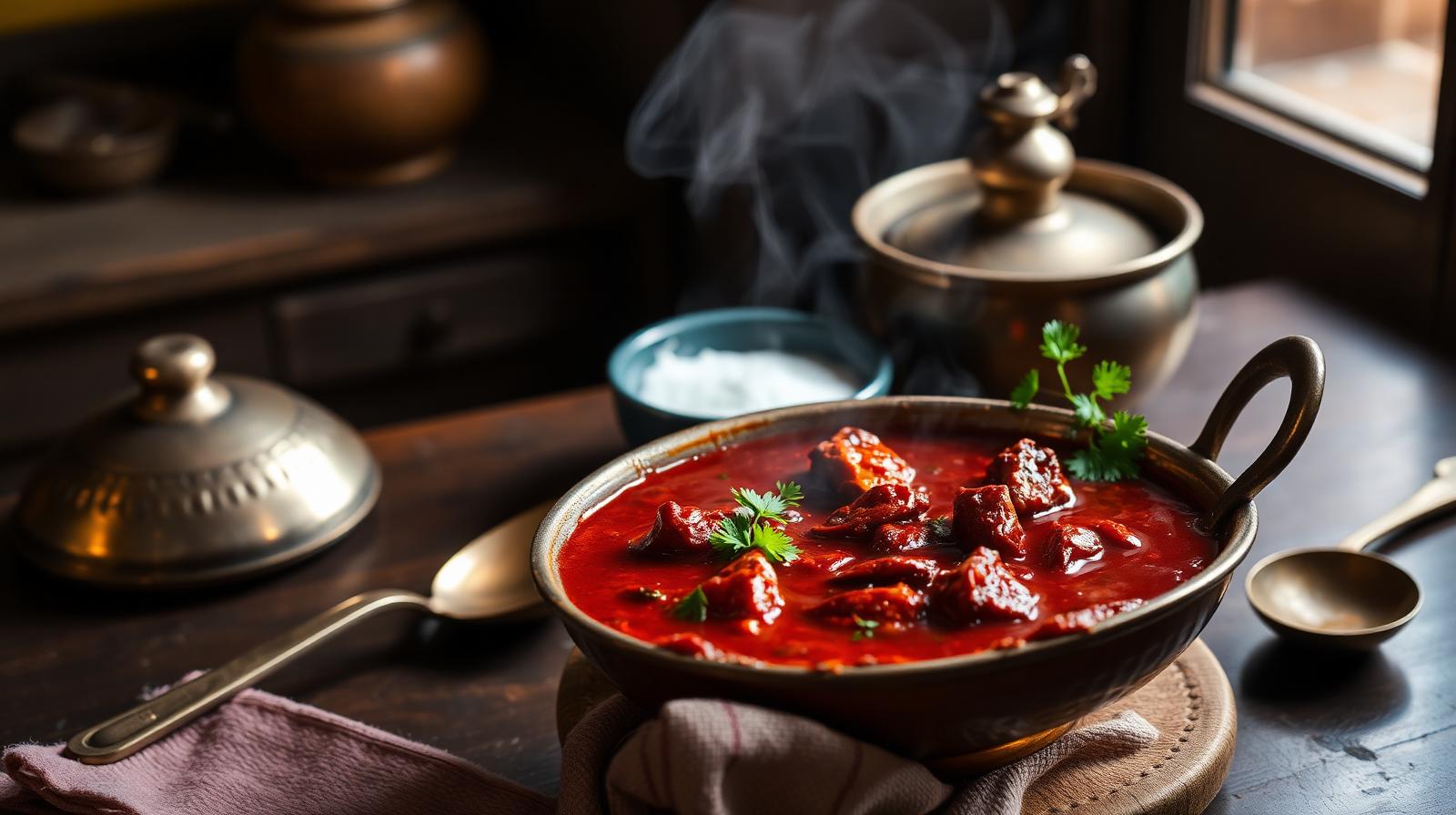
Lal maas is, in 2026, the dish every Udaipur visitor wants to taste. Most menus describe it as ancient royal cuisine. The truth is more interesting and slightly more recent. Lal maas, as we know it today — slow-cooked mutton in a deep red gravy of dried mathania chillies, ghee, yogurt, garlic and a handful of whole spices — is essentially a 19th-century invention that travelled from the hunting camps of the Mewar nobility to the palace kitchen sometime between 1870 and 1920. Three or four generations, no more.
The dish was built around the conditions of the hunt: an open fire in the Aravalli forests, a freshly killed boar or deer or, more commonly, mutton brought from the camp, dried red chillies that travelled well, ghee that did not spoil, garlic, salt. There were no tomatoes — tomatoes did not enter the Indian kitchen at scale until much later. There were no onions in the original campfire version either, which is why the most traditional palace versions you will eat in Udaipur today still have no onion in the gravy at all.
Knowing the dish is a hunter’s dish that learned palace manners changes the way you taste it. The deep red colour is not an aesthetic choice; it is the unavoidable consequence of dry mathania chilli being the only available spice that travelled into the forest in quantity. The slow cook is not refinement; it is what you do when you have a fire that is not in a hurry. The ghee is generous because ghee does not spoil. The dish is honest in the way camp food is honest.
Lal maas is not ancient royal cuisine. It is a hunter’s dish that learned palace manners.The House of Udaipurs
The Mathania Chilli, Deconstructed
The single most important ingredient in lal maas is the mathania chilli — a deep red, mildly hot, intensely fragrant chilli grown in a few villages around Mathania in Jodhpur district, about six hours west of Udaipur. Without mathania, lal maas is impossible; it becomes a generic mutton curry of indeterminate origin.
Mathania has two qualities that no other Indian chilli combines. It produces a saturated red colour — so saturated that a tablespoon of mathania paste turns a litre of yogurt the colour of a sunset — and it does this at a heat level that is significantly lower than its colour suggests. A traditional palace lal maas uses 25–30 dried mathania chillies for a kilogram of mutton, which sounds catastrophic but produces a dish that is hot enough to be respected, not hot enough to destroy the palate.
A small but growing number of Udaipur restaurants now substitute Kashmiri chilli for the colour and add a single hot chilli for the heat. The dish that results is competent but not lal maas. It tastes flatter, less aromatic, more one-dimensional. If a menu does not name the chilli, it is almost certainly not using mathania. Ask. The good places will tell you with quiet pride.
- A serving in Udaipur
- ₹450–700 at a casual Rajasthani restaurant; ₹1,800–2,800 at a heritage hotel; ₹3,500+ at the Lake Palace.
- Mathania chilli per kg of mutton
- 25–30 dried whole chillies; about 80–100g once seeded and soaked. Substantially less than the colour suggests.
- Cook time
- 90 minutes minimum on a slow fire; the best palace versions cook for 3 hours over very low heat.
Where to Taste It Properly
There is a short list of places in Udaipur that cook lal maas properly. There is a much longer list of places that cook a dish called lal maas. The difference is not subtle.
The most consistently faithful version, in our six-month survey, is at Ambrai — the lakeside restaurant attached to Amet Haveli — where the lal maas is cooked overnight, uses real mathania, contains no onion, and arrives in a small copper handi at around ₹1,200 a serving. A close second is at the Bhairo restaurant inside the Devigarh fort, where the dish is leaner, slightly less ghee-forward, and slightly hotter; the price sits around ₹2,200. The Lake Palace serves the most polished version in the city at around ₹3,500 per person on a tasting menu — historically accurate, technically perfect, and arguably over-curated.
For a less expensive but still credible plate, both Natraj on Bapu Bazaar and the Krishna Bhojnalaya thali joints serve a smaller-scale lal maas at around ₹350–550. It is heavier on the gravy and lighter on the chilli, but it is recognisably the same dish. Avoid any restaurant that lists lal maas alongside butter chicken; the kitchen is not built for either.
The chilli is the headline; the ghee is the story.The House of Udaipurs
The Etiquette of the Plate
A plate of lal maas is not eaten alone. The dish is built to be eaten with a thick wheat roti — bajra in winter, jowar otherwise — which mops the gravy in slow, deliberate movements, and with a small bowl of plain yogurt or buttermilk on the side, which resets the palate every fourth or fifth bite.
The mutton itself is, in a properly cooked version, on the bone. Boneless lal maas is not lal maas — the bone marrow is part of the gravy’s body, and a deboned version tastes immediately leaner and less complete. The pieces are usually small, palm-sized at most, cooked to the point where they barely hold together when lifted with a roti. A long fork-pull on a piece of lal maas mutton is the wrong texture; the right one is a gentle fall-apart.
Order it with a side of jeera rice or steamed plain rice rather than biryani; the biryani fights the gravy. Skip the salad. Order a glass of buttermilk or a fresh lime soda; do not order wine. The dish was developed for water, fire, and silence. Anything more is editorial.