
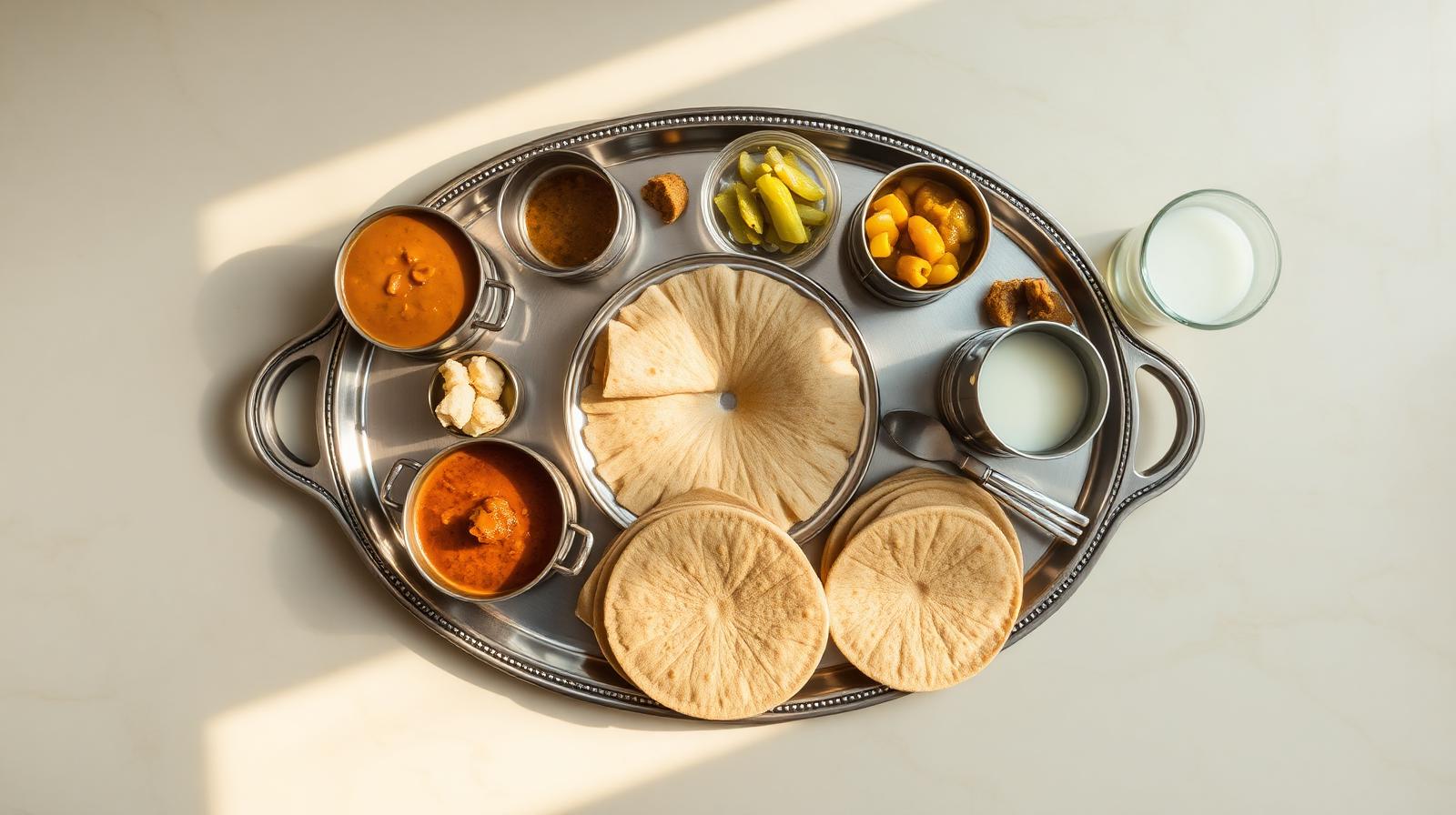
The Plate as a Map
A Rajasthani thali is not a buffet on a plate. It is a map. The position of each katori (small bowl) on the thali is fixed, the order of eating is suggested by that position, and the rhythm of refills is choreographed by the server in a way that, if you are not watching, looks effortless. None of this is announced. A first-time visitor at a household lunch in Udaipur often eats the thali in the wrong order without anyone correcting them — and it is precisely this silence that makes the etiquette worth learning.
On a traditional Mewari thali — typically silver in a heritage household, stainless steel in a working household, brass in a temple-adjacent setting — the components are arranged in a near-fixed pattern. A pile of soft rotis or bajra rotis sits at the centre or top. Around them, in a clockwise arc starting from twelve o’clock, sit small katoris of dal, kadhi, gatte ki sabzi or another seasonal sabzi, and a sweet (churma, malpua or shrikhand depending on the household). At six o’clock you will usually find a small mound of rice, a piece of papad, and a little portion of pickle. A glass of buttermilk (chaas) or cold water sits to the right of the thali, never on it.
The arrangement looks decorative. It is functional. It is designed to be eaten in a counter-clockwise spiral, savoury first and lightest first, working toward the heavier and the sweeter, with the sweet eaten in small bites between savoury ones rather than at the end. Indian meals do not have dessert at the end; dessert is interleaved.
In Mewar, the second helping is offered. The third is asked for. The fourth is declined gracefully.The House of Udaipurs
The Right Hand, Always
The most consistently noticed etiquette at a Mewari table — and the easiest one to get wrong as a visitor — is the use of the right hand for eating. The left hand is the serving hand. It pours water, it lifts the kadhi katori for a second helping, it holds the glass of buttermilk. The right hand alone touches the food.
This is not a religious rule, exactly. It is a hygiene custom that has, over centuries, hardened into etiquette. A guest using their left hand to tear a piece of roti or to scoop up dal will not be corrected; they will simply be quietly noticed. The polite move, even for a left-handed visitor, is to do the eating with the right hand and reserve the left for the glass and the napkin.
The corollary is that Rajasthani food is designed to be entirely manageable with one hand. The roti tears cleanly with three fingers and the thumb. The baati breaks with the heel of the palm. The dal is mixed into rice with the fingertips, scooped, and eaten in small mouthfuls. Cutlery exists in modern Udaipur restaurants and will be offered without comment, but a visitor who eats with their hand will be quietly approved of.
- A traditional thali in Udaipur
- ₹250–500 at a casual thali house; ₹900–1,400 at a sit-down restaurant; ₹2,200–3,500 at a heritage hotel.
- Number of katoris on a complete thali
- 7–11, depending on the season and the household.
- Length of a proper thali meal
- 40–55 minutes, eaten without rushing. Restaurants that hurry you out have the wrong understanding of the dish.
The Choreography of the Refill
A Rajasthani thali is, by tradition, refillable. The server — a family member at home, a uniformed waiter at a restaurant — circles the table with a small bucket of dal, a small kettle of kadhi, a tray of fresh rotis, and refills are offered without being asked. The etiquette around the refill is the most subtle part of the meal.
The first helping is the question. The host or server is, with the first refill, asking whether you are enjoying the dish. The second helping is the answer — accepting it is a quiet compliment to the cook, declining it is a quiet but acceptable signal that you are full. The third helping is generally asked for by the guest rather than offered. The fourth, if it ever happens, is declined gracefully on both sides.
A guest who eats nothing of a particular dish without explanation makes the cook anxious. A guest who eats one bite and quietly says "this is wonderful, but my stomach is small today" closes the loop. Saying "no, thank you" with a small palm-down gesture over the katori is the universal sign that you are done with that dish for now. The server will move on without comment.
The right hand eats. The left hand serves. Confusing the two is the only mistake the table will quietly notice.The House of Udaipurs
The Buttermilk Comes Last
The glass of chaas — buttermilk, lightly salted, faintly seasoned with cumin and a torn curry leaf — is the closing punctuation of a Rajasthani meal, not its accompaniment. It is sipped at the very end, after the last bite of churma, sometimes with a small piece of fennel-and-sugar mukhwas chased afterwards.
A first-time visitor often makes the mistake of drinking the chaas alongside the meal, the way a Westerner drinks water. This is not wrong, exactly. But it is the wrong rhythm. The chaas is meant to settle the meal, neutralise the chilli and the ghee, and signal to the table that you are finished. Drinking it early is the gastronomic equivalent of leaving a meeting before the closing remarks.
A polished Mewari host will time the buttermilk’s arrival to the moment your hand reaches for the napkin to wipe your fingers. It will appear quietly, in a small steel glass, lightly cool but not iced. Drink it slowly, thank the cook by name, and the meal is complete. Anything offered after — a paan, a glass of warm haldi-doodh in winter — is generosity, not obligation.