
The Quiet Signature
Mewar’s palace cuisine is widely understood as a story about spice — mathania chillies, saffron from Kashmir, the long pepper of the desert, the dried mango of the monsoon kitchen. This is true and well-documented. The deeper, less-told story of the same cuisine is about ghee — clarified butter — and the surprisingly political role it played in the Mewar palace kitchen between roughly 1600 and 1947.
A Mewar palace kitchen, at any point in the four centuries between Maharana Pratap’s consolidation and Independence, had two distinct store rooms: a smaller one for spice, and a larger one for ghee. The ratio of these rooms is the story. Spice in the Mewari kitchen was used measured in grams; ghee was used measured in kilograms. A single royal feast for two hundred guests at the City Palace in the 1920s consumed an estimated 14–18 kilograms of ghee in the savoury kitchens alone, and another 8–10 kilograms in the sweet kitchen.
Ghee was the ingredient that defined whether a dish was a household dish or a palace dish. The recipe could be identical. The household version was cooked with a tablespoon of ghee for tempering; the palace version was cooked with a quarter-litre. The dish that resulted was richer, glossier, longer-lasting (ghee is a preservative), and unmistakably a palace dish in a way no spice could replicate.
In a Mewar palace kitchen, the ghee-keeper outranked the spice-keeper. The dish told you who was winning.The House of Udaipurs
Where the Ghee Came From
The Mewar court did not buy ghee on the open market. Ghee for the palace kitchen was sourced through a controlled supply chain that connected directly to a network of approved rural households, mainly in the villages around Nathdwara and Eklingji, who maintained dedicated cattle herds for palace supply. The arrangement was hereditary; a family that supplied ghee to the palace in the 1750s was, in many cases, still supplying ghee in the 1920s.
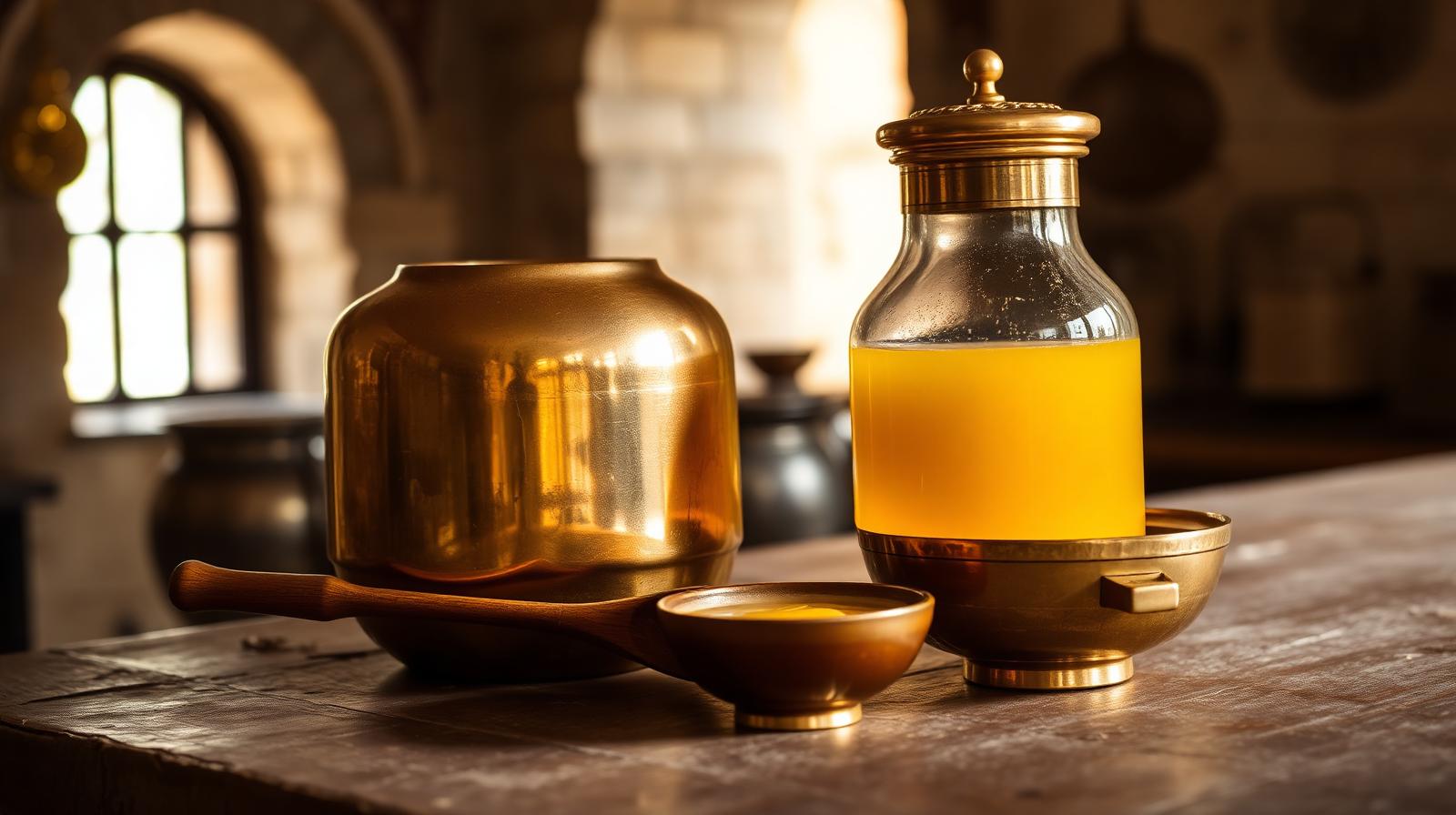
The reason for this controlled sourcing was quality, not exclusivity. Palace ghee was made from the milk of cows fed on specific monsoon grasses and a small fixed proportion of dried desert herbs; it was churned by hand in small batches, clarified slowly over a wood fire, and stored in large brass jars that were hand-finished by the same families generation after generation. The ghee that resulted was deeper in colour, longer in finish, and slower to spoil than commercial ghee — which is why a 1920s palace ghee jar, opened today in a Mewar archive, still smells faintly of itself a century on.
Two centuries of this arrangement created a small but powerful position in the palace kitchen: the ghee-keeper. The ghee-keeper was a senior staff member who controlled access to the ghee store, decided how much each cook could draw per day, and in many cases set the actual menu by deciding what the kitchen could afford to cook. By the late 19th century, the ghee-keeper outranked the head spice-keeper in the daily hierarchy of the kitchen — a quiet but absolute reflection of which ingredient the cuisine was really built around.
- Ghee per royal feast (200 guests)
- 14–18 kg in savoury kitchens; 8–10 kg in the sweet kitchen.
- Daily ghee allocation per chef
- Around 2.5 kg, drawn against signed kitchen records — many of which survive in the City Palace archive.
- Palace ghee suppliers, c. 1900
- ~40 hereditary households, mainly in villages around Nathdwara and Eklingji.
The Politics of the Spoon
Because ghee was both expensive and central, the kitchen developed an entire layer of politics around its use that has no real parallel in modern restaurant kitchens. A cook who used too little ghee was producing a household dish; a cook who used too much was wasting the kitchen’s most controlled resource. The right amount, in the right dish, in the right week of the year, required judgment that was learned over decades.
Surviving palace kitchen records from the 1880s show that disputes over ghee consumption were the single most common form of staff conflict in the City Palace kitchens — more common than seasoning, more common than presentation, more common than caste or hierarchy disputes. The ghee-keeper resolved these disputes; the head chef appealed to the master of household; the master of household, on rare occasions, took the matter to the Maharana himself, who almost always sided with the ghee-keeper.
The dishes that emerged from this politics are the ones we still eat today. Lal maas — ghee-rich, slow-cooked, finished with a final spoon of ghee at service. Safed maas — built on a yogurt-and-cashew base with a generous ghee tempering. Mawa kachori — a sweet kachori filled with ghee-cooked khoya. Each of these dishes carries, in its ghee content alone, the quiet signature of a kitchen that knew what its real currency was.
Spice is the headline of Rajasthani food. Ghee is the grammar.The House of Udaipurs
What Survives Today
In 2026, the politics of ghee are no longer politics — they are habit. But the habit is intact in surprising places. The royal kitchen of the City Palace, which still operates as a small heritage operation cooking historically accurate Mewari menus for select events, sources its ghee from three of the original supplier families and uses, by official record, around twice the ghee per dish that an equivalent restaurant kitchen would use. The dishes that result are noticeably different — richer, glossier, slower to digest, and unmistakably palace cuisine.
A handful of restaurants in Udaipur still cook in this register. Ambrai’s lal maas is one; the historic-menu tasting at the Lake Palace is another. Both use ghee in proportions that a modern nutritionist would gently object to and that a Mewari grandmother would consider appropriate. Both are, for that reason, the closest living link to the palace kitchen the visitor can taste.
A short walk into the small ghee-and-mithai shops in the Bada Bazaar area near Jagdish Temple is the cheapest way to taste this lineage. A 250g jar of cow ghee from one of the older shops costs around ₹450–600 in 2026; a single mawa kachori, eaten warm at the counter, costs ₹40. Both are made in the technique the palace kitchens used. Both are, in a small way, edible history.