
The Door Most Visitors Walk Past
Inside the City Palace, after the Mor Chowk and before the Crystal Gallery queue, there is a low arched doorway on the left of a small landing. It is not signposted. A small handwritten card reads simply: Zenana Mahal — included. Most visitors miss it; of those who notice it, perhaps one in five turns in. The other four follow the main route up to the Crystal Gallery.
This is the entrance to the women's quarters of the palace — the wing where the queens, princesses and royal women of the Mewar court lived from the late seventeenth century until 1947. The Zenana is included in the standard City Palace ticket (₹400 in 2026 for foreign nationals, ₹250 for Indian nationals) and takes between forty minutes and an hour to walk slowly.
It is also the only wing of the palace where you will, at most times of day, find yourself alone in a courtyard for two or three minutes at a stretch.
The Zenana is the only wing of City Palace where the architecture moves slower than the visitor. That is why it is empty.The House of Udaipurs
The First Courtyard — Lakshmi Vilas
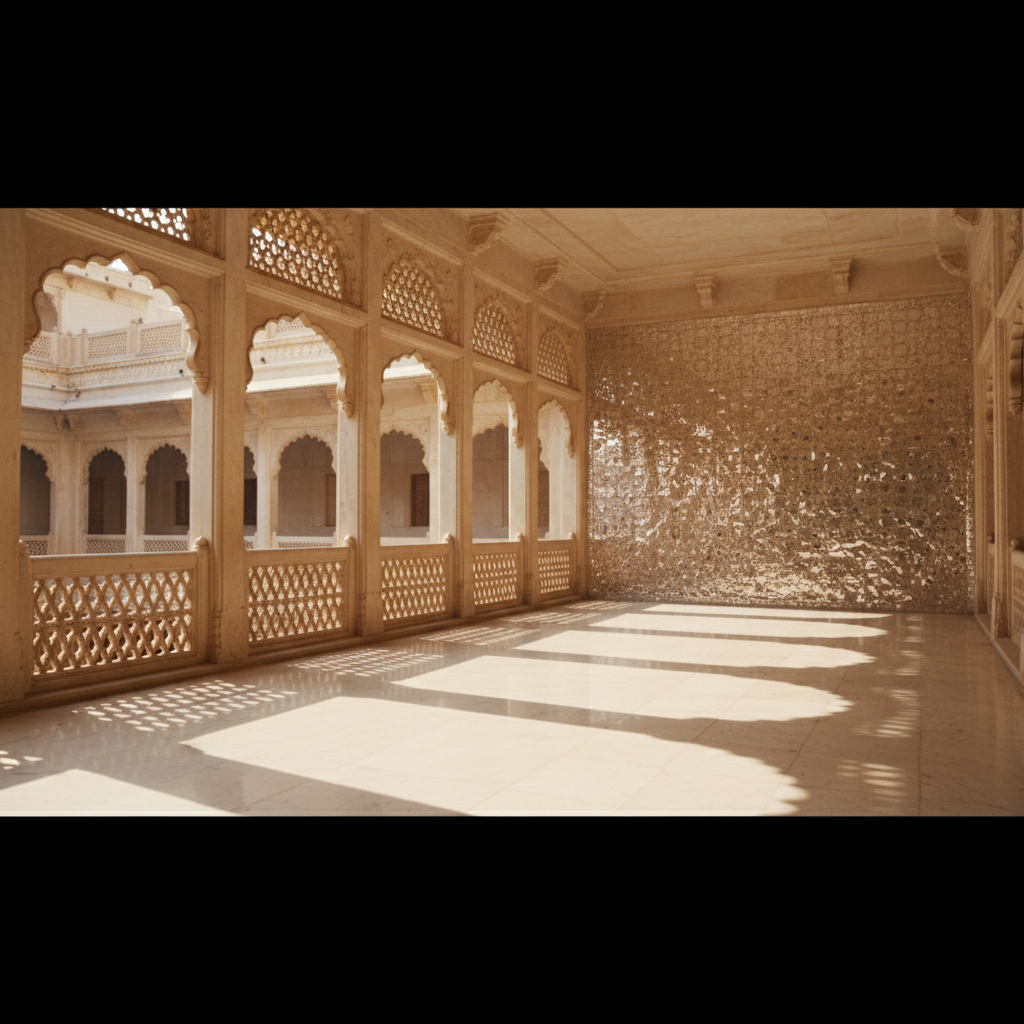
The Zenana opens into Lakshmi Vilas, the first and largest of its four interior courtyards. The courtyard is roughly fifteen metres square, paved in cream limestone, and surrounded on all four sides by a covered colonnade carved with delicate lobed arches. The walls of the colonnade carry the palace's most intricate jali screens — pierced stone lattices that allowed the zenana women to see out into the courtyard without being seen from it.
The jali work here is mid-eighteenth century, cut from a single block of marble per panel. Each panel is roughly 1.5 metres square. The patterns are geometric — six-pointed stars, hexagonal honeycombs, intersecting circles — and were designed so that the play of sunlight through them would shift slowly across the courtyard floor through the day, marking time the way a sundial does.
Stand in the centre of the courtyard at any time between 10am and 2pm, look down at the floor around you, and you will see the lattice shadows tilting visibly across the stone. The whole courtyard is, in a quiet engineered sense, a clock.
The Frescoed Wing
A small passage leads from Lakshmi Vilas into the second courtyard, smaller and more enclosed, called Bhim Vilas. The walls of the colonnade here carry the Zenana's most extensive painted programme — frescoes in the late Mewar manner, painted between 1740 and 1780 on lime plaster prepared with fine sand and shell powder.
The subject matter is unusual for a palace context. Most Mewar palace frescoes depict royal hunts, courtly scenes and Krishna mythology. The Bhim Vilas frescoes depict women — almost exclusively women — at small daily tasks: combing their hair, playing chaupar, feeding peacocks, applying mehndi, watching the monsoon from a balcony. The palette is soft: faded green, rose, gold, ochre. The figures are small, never larger than fifteen centimetres tall, scattered across the walls in seemingly informal arrangements.
The frescoes have not been restored. The pigments you see are the original mineral-based palette laid down between 1740 and 1780, faded gently across two and a half centuries. Conservation has consisted only of gentle cleaning and stabilisation. They are, by any reasonable measure, the finest non-religious fresco programme in any Rajput palace.
- Hours
- Open with the standard City Palace ticket: 9:30am–5:30pm daily, last entry 4:30pm.
- Best window
- Weekday mornings 9:30–10:30am — group tours arrive after 10:30 and head straight to the Crystal Gallery.
- Time required
- 40–60 minutes for the slow walk through all four courtyards.
- Photography
- Permitted in courtyards (no flash); not permitted on the painted walls of Bhim Vilas — please respect the request.
The frescoes have not been restored. They have only been allowed to last.The House of Udaipurs
The Mirror Courtyard and the Gardens
A short flight of stairs from Bhim Vilas leads up to the third courtyard, smaller still, with mirror inlay (sheesh kaam) covering the upper sections of all four walls. Thousands of small convex mirrors — each one cut and set by hand into the lime plaster — catch the light from a single skylight and throw it across the courtyard in a soft, broken constellation.
In the eighteenth century this courtyard would have been lit at night by oil lamps; the mirrors would have multiplied each flame into a hundred small points of light, turning the entire courtyard into something like the inside of a softly burning lantern. The skylight has been left clear and the mirrors have not been silvered or replaced — what you see is the original installation, slightly dimmed by time but otherwise intact.
The fourth and final courtyard is the smallest — a narrow garden court with two stone water channels running its length, four mature champa trees, and a low marble parapet on the south side overlooking Lake Pichola. This was the queen's private terrace. Sit on the parapet for five minutes. The view of the lake from here is the only view in the entire City Palace that is at the same height as Jagmandir island. That is not a coincidence.
Why It Stays Quiet
The Zenana stays quiet for two reasons. The first is that group tours are routed straight from Mor Chowk to the Crystal Gallery, which has the highest ticket value attached to it; group leaders have ten minutes to make per stop and the Zenana does not fit. The second is that the Zenana asks for slowness — there is nothing here that photographs well in three seconds, no single object to point a phone at, no obvious "view".
This is a feature, not a flaw. The Zenana is the part of City Palace that rewards the visitor who is willing to spend thirty minutes inside two small courtyards looking carefully at lattice shadows and faded fresco. There are perhaps three or four such visitors in the wing at any time. The courtyards themselves were designed for that pace.