
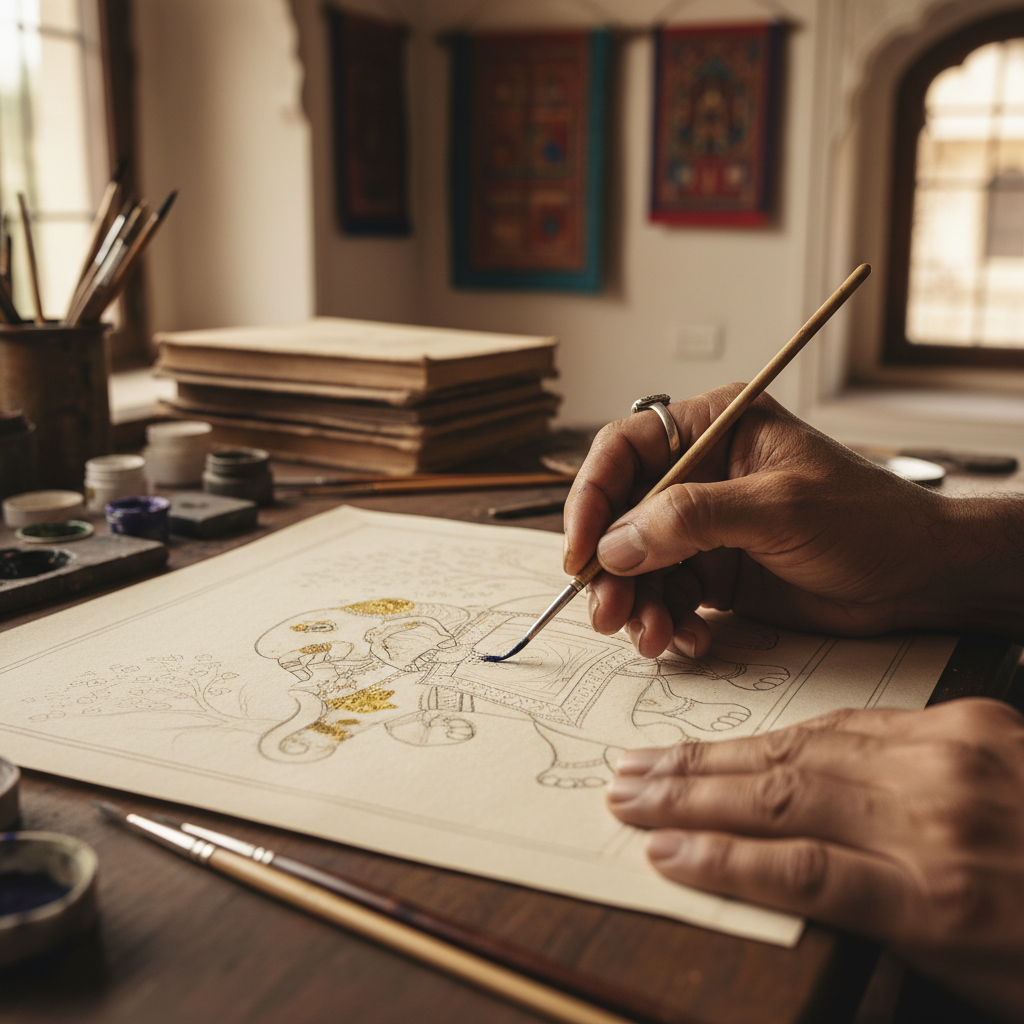
The Atelier Above the Courtyard
On the second floor of Bagore-ki-Haveli, in a north-facing room with two arched windows and a single low-watt bulb, three men sit cross-legged on a cotton durrie and paint. They have been painting since seven this morning. They will paint until the natural light fails around five. None of them will look up unless spoken to first.
This is the working atelier of the Sharma family — fifth generation of Mewar-school miniaturists, descended from a karkhana attached to the City Palace in the late nineteenth century. They are one of six families still practising the Mewar miniature in Udaipur in 2026. The other five are scattered across two floors of the same haveli and a small workshop in Kankarwa.
The room itself is the inheritance. The paint table is teak, blackened by a century of pigment splashes. The brush jar holds eighteen squirrel-hair brushes, the smallest of which is a single hair. The pigment shelf carries fourteen open clay pots — lapis lazuli ground in Jaipur, vermilion from Rajasthan, malachite from Pakistan, white from crushed seashell, gold from beaten leaf. Nothing on the table is from this century.
A jar of ground lapis lazuli lasts one painter four years. The painter has to last longer.The House of Udaipurs
The Paper Comes First
The Mewar miniature is built on wasli — a hand-burnished paper made by laminating four to seven sheets of fine cotton tissue with a gum-arabic paste, weighting them under stone for three days, and polishing the surface with a smooth agate burnisher until it reflects light like worn ivory. Wasli is made in Sanganer, a single workshop. A sheet costs ₹350 in 2026 and arrives in Udaipur in batches of fifty, twice a year.
You can paint a Mewar miniature on cartridge paper. It will not be wrong, exactly, but it will not last and it will not glow. The wasli surface is what gives mineral pigment its particular saturation — pigments sit on top of wasli rather than soaking into it, which is why a 17th-century Mewar folio still looks freshly painted under museum glass while a Mughal folio of the same era often does not.
Mr Sharma estimates he uses four sheets of wasli a year. Each finished folio is roughly A5 size. Each sheet takes him between three and six months to fill, depending on whether the commission is a single-figure portrait or a full courtly scene with twenty figures, two horses, an elephant and a peacock.
Pigment Is the Slowest Step
The pigments are mineral, ground by hand, mixed fresh every morning. Lapis lazuli — the deep ultramarine of Krishna's skin and the night sky — is bought in palm-sized chunks, broken with a small hammer, ground in a marble mortar for forty minutes per teaspoon, then suspended in a wash of gum arabic and stored in a clay pot covered with a damp cloth.
Vermilion is the same. Malachite, white, ochre, and the various earth reds — all ground by hand, all suspended fresh. Only the gold is bought ready-prepared, in tiny squares of beaten leaf imported from Bikaner, picked up with a wet brush and laid carefully into outlined areas of the painting.
The slowness is not nostalgia. Machine-ground pigments are too fine and lose their shimmer; commercially-suspended pigments separate badly under the long, slow brushwork the Mewar style requires. The hand-ground pigments hold their colour for three to four hundred years. The artist is, in a real sense, painting for someone in 2400.
- Time per finished folio (A5)
- 4–6 months for a single-figure portrait; 8–14 months for a full courtly scene.
- Pigments still ground by hand
- All except gold leaf — lapis, vermilion, malachite, ochre, white, indigo.
- Brushes per atelier
- 14–22 active brushes, smallest a single squirrel-tail hair, sourced from one workshop in Jaipur.
- Commission price range
- ₹35,000–4,50,000 depending on size, complexity and pigment cost.
The Mewar miniature did not survive because anyone tried to save it. It survived because six families never stopped.The House of Udaipurs
Why Six Families, and Why Still
In 1947 there were thirty-eight working Mewar-miniature ateliers in Udaipur. By 1985 there were eleven. By 2010, eight. There are six in 2026 — the Sharmas, the Sonis, the two Joshi households, the Kankarwa workshop, and the youngest atelier, Hem Lata Kumawat's small studio in the Pichola lanes, founded in 2014. None has more than four working painters.
The reason there are still six is that the demand never quite ended. Heritage hotels commission folios. Museums and private collectors abroad commission them. The City Palace itself maintains a small standing commission. The six families do not advertise; they do not need to. Each has a five-to-eight-year waiting list.
The reason there are not more is that the apprenticeship is twelve years. Eight of those years, the apprentice does almost nothing visible — they grind pigments, prepare paper, copy outline drawings, sweep the floor of the atelier. Few teenagers in 2026 will commit to that. The Kumawat studio took on three apprentices in 2018; one is still painting.
Visiting and Buying
You can visit the Bagore-ki-Haveli atelier wing as part of a regular ticket (₹100 in 2026). The Sharmas are usually open to a quiet observer for ten or fifteen minutes; the others vary. None will perform for you. None will sell to you on the spot.
A finished folio, if you want to commission one, requires a written enquiry to the atelier — usually relayed through the haveli office or through a Udaipur-based heritage concierge. You agree on subject, size and price; you wait six to fourteen months; the work arrives by hand-delivered courier in a hand-painted wooden case. The case alone is the work of a separate Udaipur woodworker and is, in its own quiet way, a second piece of art.
For everyone else, a small selection of completed folios is exhibited and sold through the City Palace shop and through one careful gallery on Hathi Pol road. The prices are real. The folios are, unmistakably, the slow result of a tradition that did not, against expectation, end.