
Cue One — The Lapis Sky
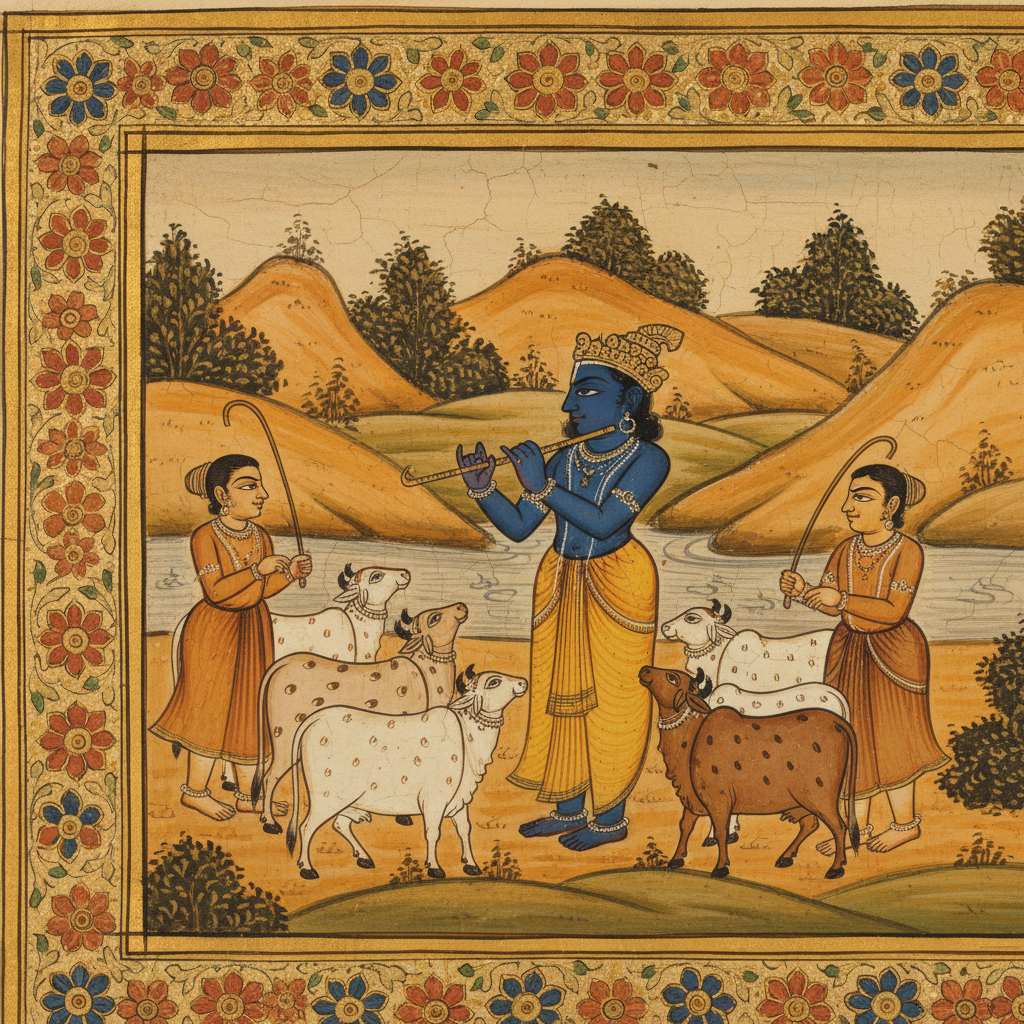
A genuine Mewar miniature has a sky painted in pure ground lapis lazuli — the deepest, most saturated blue you will see on any Indian miniature painting. The blue is not atmospheric, not graduated, not softened toward the horizon. It sits as a flat, intense band across the top quarter of the folio.
The reason is technical. Mewar painters used hand-ground lapis from the late fifteenth century onward, sourcing the stone via Jaipur dealers from Afghan mines. Lapis was the most expensive single ingredient in the atelier — a single folio with a full lapis sky could cost the equivalent of a working man's month's wages in pigment alone. The ateliers used it anyway, because the colour was the school's signature.
Mughal miniatures use a softer, often greener-blue sky derived from a mixture of indigo and white. Kishangarh skies are misty and graduated. Bundi skies are smaller and more decorative. Only Mewar gives you that uncompromising flat lapis band. Twenty seconds at the top of the folio tells you almost everything.
The Mewar painters chose flatness in 1580 and held it for three hundred years. That is not naivety. That is theology.The House of Udaipurs
Cue Two — The Flat Perspective
Mewar painting is uninterested in perspective in the European or Mughal sense. Figures stand in stacked horizontal registers; the ground is shown as a flat coloured band rather than a receding plane; buildings are drawn either head-on or in a charming half-elevation that shows two walls and a roof simultaneously.
This is not naivety. It is doctrine. The Mewar school inherited its compositional grammar from earlier Jain and Western Indian palm-leaf manuscript painting (12th–14th c.), where flatness was a positive theological claim — the painted world was not meant to imitate optical reality. When the Mughals introduced perspective into Indian painting in the 1580s, the Mewar ateliers noted it, considered it, and chose not to adopt it.
Bundi adopted partial perspective by the 1670s. Kishangarh adopted full Mughal-style perspective by the 1730s. Mewar held the line into the late nineteenth century. If a folio looks decisively "stacked" rather than "receding", it is almost certainly Mewar or one of the Mewar-derived schools (Devgarh, Nathdwara).
Cue Three — The Eye
Mewar figures are drawn in three-quarter profile with one large, fully-visible, almond-shaped eye that sits noticeably high on the face. The eye is outlined in fine black, often filled with white, and the iris is a distinct dark dot. It is the single most recognisable Mewar feature.
Mughal profiles by contrast carry a smaller, more naturalistic eye, often with a heavy upper lid. Kishangarh profiles famously elongate and stylise the entire face — the nose lengthens, the chin recedes, the eye stretches in a very particular slow curve. Bundi profiles compress the features more tightly together.
There is also a Mewar convention specific to female figures: the eye carries a small extension of the outline beyond the corner of the eye toward the temple — a graceful flick that the school called the "fish-tail". A genuine seventeenth-century Mewar female face will almost always show it.
- City Palace Museum
- ~600 folios in the Mewar wing; entry ₹400 in 2026; allow two hours minimum.
- Bagore-ki-Haveli Museum
- Smaller curated display + working ateliers on the upper floor; entry ₹100.
- Crystal Gallery / Durbar Hall
- A few important framed folios held within the City Palace complex; included with palace ticket.
- Reference reading
- Andrew Topsfield, *Court Painting at Udaipur* (Artibus Asiae, 2002) — the definitive academic text in English.
Lapis at the top, vermilion at the bottom, one large eye in between. That is the school in three sentences.The House of Udaipurs
Cue Four — The Vermilion Ground
Mewar grounds — the bands of earth at the bottom of the folio — are painted in a particular saturated vermilion red, often with fine white floral motifs scattered across the band. The vermilion is hand-ground from raw cinnabar, suspended in gum arabic, and applied in three thin layers to achieve its saturation.
No other Rajasthani school uses ground red so prominently. Mughal grounds are typically green or buff; Kishangarh grounds favour soft pinks and creams; Bundi favours mustard yellow. Mewar's vermilion ground, paired with the lapis sky, gives the school its instantly identifiable colour signature: deep blue above, deep red below, and the painted scene held between them.
In late Mewar work — eighteenth and nineteenth centuries — the ground sometimes shifts to a softer terracotta or earth red. Pure vermilion remains the seventeenth-century mark.
Cue Five — The Border
The final cue is the border. A genuine Mewar folio carries a multi-band border: a thin black inner rule, a wider band of plain colour (most often deep red, ochre or dark green), then a finer outer band painted with gold-leaf floral or geometric motifs, finished with a final thin black line.
The gold-leaf band is the giveaway. Mewar borders almost always have it; Bundi often does not; Mughal borders are typically more elaborate floral compositions in colour rather than gold; Kishangarh prefers wider plain pastel bands. The gold-leaf in a genuine seventeenth-century border has a particular flat, slightly burnished quality from the original beating process.
Modern Mewar reproductions — sold across Udaipur tourist shops at ₹500–5,000 — usually skip the gold-leaf border or replace it with printed gold ink. The border, in other words, is the last cue you check and the first cue that tells you whether you are looking at the real thing.