
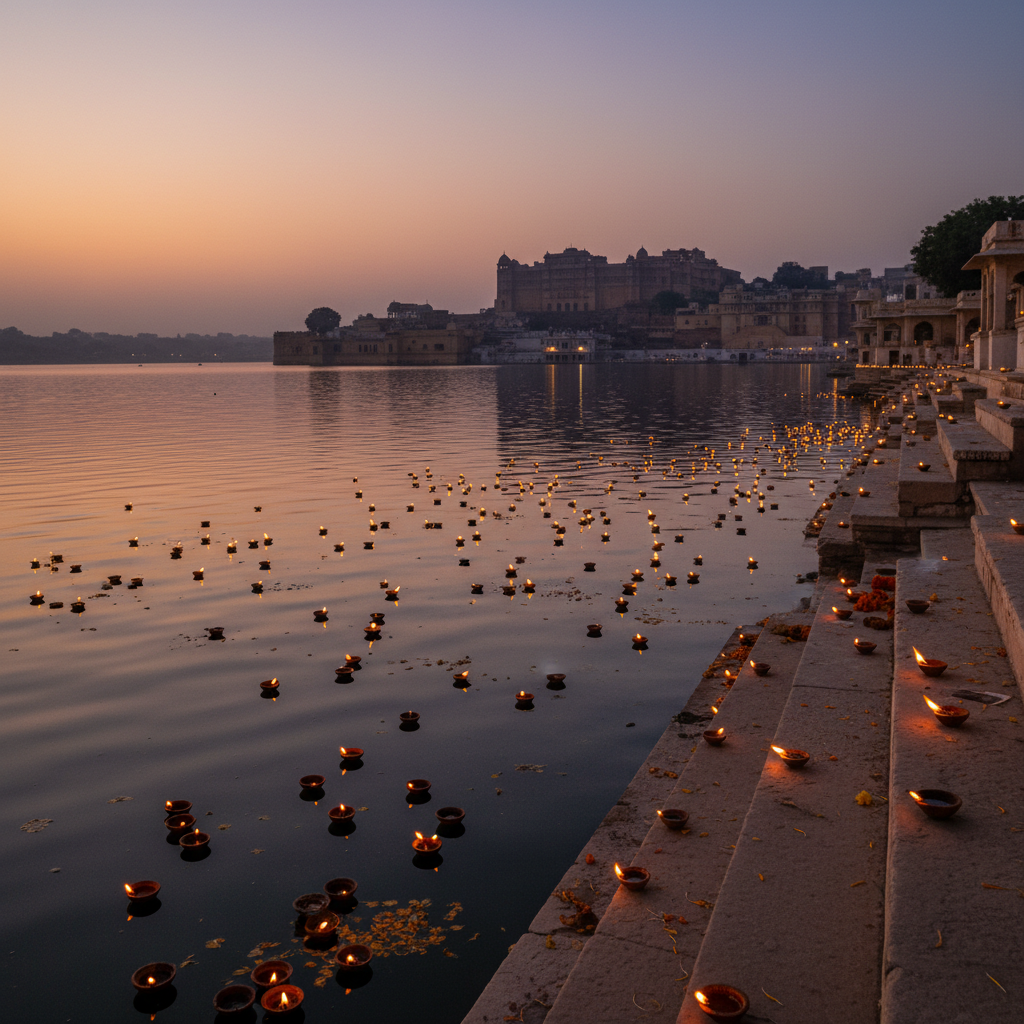
When the Aarti Ends
The evening aarti at Gangaur Ghat is performed every day around 6:45pm in winter, 7:15pm in summer. It draws between two hundred and five hundred people, depending on the season — visitors, locals, photographers, the small handful of pilgrims who actually came for the prayer. By the time the brass bell rings final and the priest begins the slow lamp circle, the steps are full.
And then, within fifteen minutes, the steps empty. The visitors have a dinner to get to. The photographers fold their tripods. The pilgrims sit a moment longer, then leave. By 7:15 in winter — quarter past seven, with the last orange still draining from the sky — the ghat is, astonishingly, almost yours.
This is the walk to take then. It runs forty minutes, covers four ghats, and shows you a Pichola that no daytime visit and no rooftop dinner reveals. The brass lamps left on the water still burn for another twenty minutes. The water is glass. The City Palace catches the last of the sodium lights coming on across the lake.
The half-hour after aarti is the only time in twenty-four hours that the ghats are neither tourist nor temple — only themselves.The House of Udaipurs
Gangaur Ghat to Lal Ghat
You begin where the aarti was. Gangaur Ghat is the most photographed of the four — wide cream-stone steps descending in three terraces, a small Gangaur shrine to the left, a centuries-old peepul tree at the top step. Stand at the water's edge for a moment. The diyas left from the aarti drift slowly south, two or three of them still lit, their reflections doubling on the still water.
Walk left, north along the lake edge. The lane narrows. After about eighty metres you reach Lal Ghat, smaller, less photographed, with a quieter set of steps and a small red sandstone marker — hence the name. This is where Udaipur households brought their evening washing before piped water; a few elderly women still wash clothes here in the morning out of habit.
Lal Ghat at this hour is empty. The lake water laps very softly against the bottom step. Across the lake, the Lake Palace floats in a small halo of its own light. Stand for two minutes. This is the Pichola most photographs cannot record.
The Crossing to Ambrai
From Lal Ghat, you have two options. The slower walk takes the long pedestrian loop around through the Old City, past the Daiji footbridge — about fifteen minutes — to reach Ambrai Ghat on the western bank. The faster walk takes a shared boat from the Lal Ghat jetty (₹40 in 2026, runs until about 8pm), ten minutes across the water.
Take the boat. It is the only way to feel the lake from the inside, and at this hour it is almost empty — usually a single boatman and you. The crossing is straight, slow and quiet. The City Palace becomes a wall of golden windows on the right; the Lake Palace turns its back to you on the left; the ghats you just walked become a line of silvered steps behind.
You arrive at Ambrai Ghat — broader, lower, with a long terrace in front of the Amet Haveli hotel. This is the ghat most heritage hotels use for their wedding photographs. It is also, after dinner, completely empty. Walk the length of the terrace, sit on the parapet, and look back across the lake at the route you have just walked. The City Palace has now caught its full evening lighting and is the colour of butter.
- Best time
- Twenty to forty minutes after the daily aarti finishes — roughly 7:00–7:40pm winter, 7:30–8:10pm summer.
- Total walking time
- ~40 minutes including a 10-minute lake crossing.
- Crossing fare
- ₹40 per person on the shared Lal Ghat–Ambrai jetty boat (last boat ~8pm).
- What to wear
- Closed shoes for ghat steps; a light shawl in winter; remove shoes only inside small ghat shrines.
Pichola has two faces. The famous one belongs to the day. The honest one belongs to ten past seven.The House of Udaipurs
Ambrai to Bhansi Ghat
From Ambrai Ghat, walk south along the western bank for about ten minutes through the small lanes of Hanuman Ghat neighbourhood. The path is well-lit, completely safe, and follows the lake edge most of the way. You pass three small private ghats belonging to old Udaipur families — they are gated, but the gates are usually open — and one tiny temple ghat that holds an evening lamp until late.
Bhansi Ghat is the smallest of the four. It is built on a rocky outcrop and steps down in five short terraces directly into deep water. There is no shrine here, no aarti, no obvious history — it is simply where Udaipur boys come to swim in the warm months and where, in the cool months, two or three older men sit smoking cheroots in absolute silence.
This is the end of the walk. From Bhansi Ghat you can see, almost in a single line, all four ghats you have just covered — Gangaur and Lal across the lake to the east, Ambrai a few hundred metres to the north on your bank, and the small private ghats between. The whole loop sits inside one slow look. That is, for thirty minutes, the city the brochures cannot show you.