
The Throne That Was Never Sat On
The throne in the Diwan-i-Khas of Udaipur City Palace has been formally vacant for thirteen hundred years. The Maharanas of Mewar do not, by tradition, sit on it. They sit beside it, on a cushion to the right. The throne itself belongs to Eklingji — the four-faced form of Shiva housed in a small whitewashed shrine twenty-two kilometres north of the city — and the Maharanas, for thirteen centuries, have ruled Mewar as his diwan: his deputy, his manager, his viceroy on earth.
This arrangement was instituted in 734 CE by Bappa Rawal, the founding ancestor of the Mewar dynasty, after he received initiation from a hermit-saint named Harit Rashi at the spot where Eklingji stands today. Bappa Rawal accepted the kingship of Mewar on the explicit condition that Eklingji would remain the true ruler. Every Maharana since — through 76 successions, through Mughal sieges and Mughal alliances, through the Maratha incursions and the British residency and Indian independence — has formally ruled in the name of, and on behalf of, this small shrine.
It is not a metaphor. The shrine is administered by the present custodian of the dynasty, Shriji Arvind Singh Mewar, in his capacity as diwan. The annual financial accounts of the temple are still presented to the head of the family, in the same form they have been for centuries. This is the longest-running constitutional arrangement of any kind anywhere in India.
For thirteen hundred years the throne of Mewar has been formally vacant. The kings have always sat to the right of it.The House of Udaipurs
Getting There, and the Two Visit Windows
Eklingji sits in the small temple village of Kailashpuri, twenty-two kilometres north of Udaipur on the Nathdwara road. By car the drive is forty-five minutes; by shared taxi from Chetak Circle it is around an hour for ₹120 per seat in 2026; by private taxi expect ₹1,800–2,400 for a round trip with two hours of waiting time. There are no organised group tours, which is part of why the shrine remains as it does.
The temple opens twice daily. The morning window is 4:30am to 7:00am — the only window in which the sanctum is opened immediately after the abhishekam (ritual bathing) of the lingam, and the only window in which you will encounter the temple in something close to its eighth-century quietness. The midday window is 10:30am to 1:30pm and is busier with regional pilgrims. The temple closes for the long afternoon and reopens briefly for the 5:00pm aarti, but visitors are usually discouraged from arriving for that without a specific devotional intent.
For an unhurried first visit, leave Udaipur at 5:30am, arrive at 6:15am, spend an hour at the shrine and the sacred tank, and return to a late breakfast in the city by 8:30. This is, by some distance, the most rewarding two-hour heritage outing within striking distance of Udaipur.
The Shrine Itself
The current Eklingji shrine is fifteenth-century in its main fabric — rebuilt in white marble by Maharana Mokal in the 1430s after an earlier stone temple was damaged in the fourteenth-century Delhi Sultanate raids — with significant additions in the seventeenth century by Maharana Raj Singh I. The original eighth-century shrine was almost certainly smaller and built of locally-quarried sandstone; nothing of that fabric survives above ground.
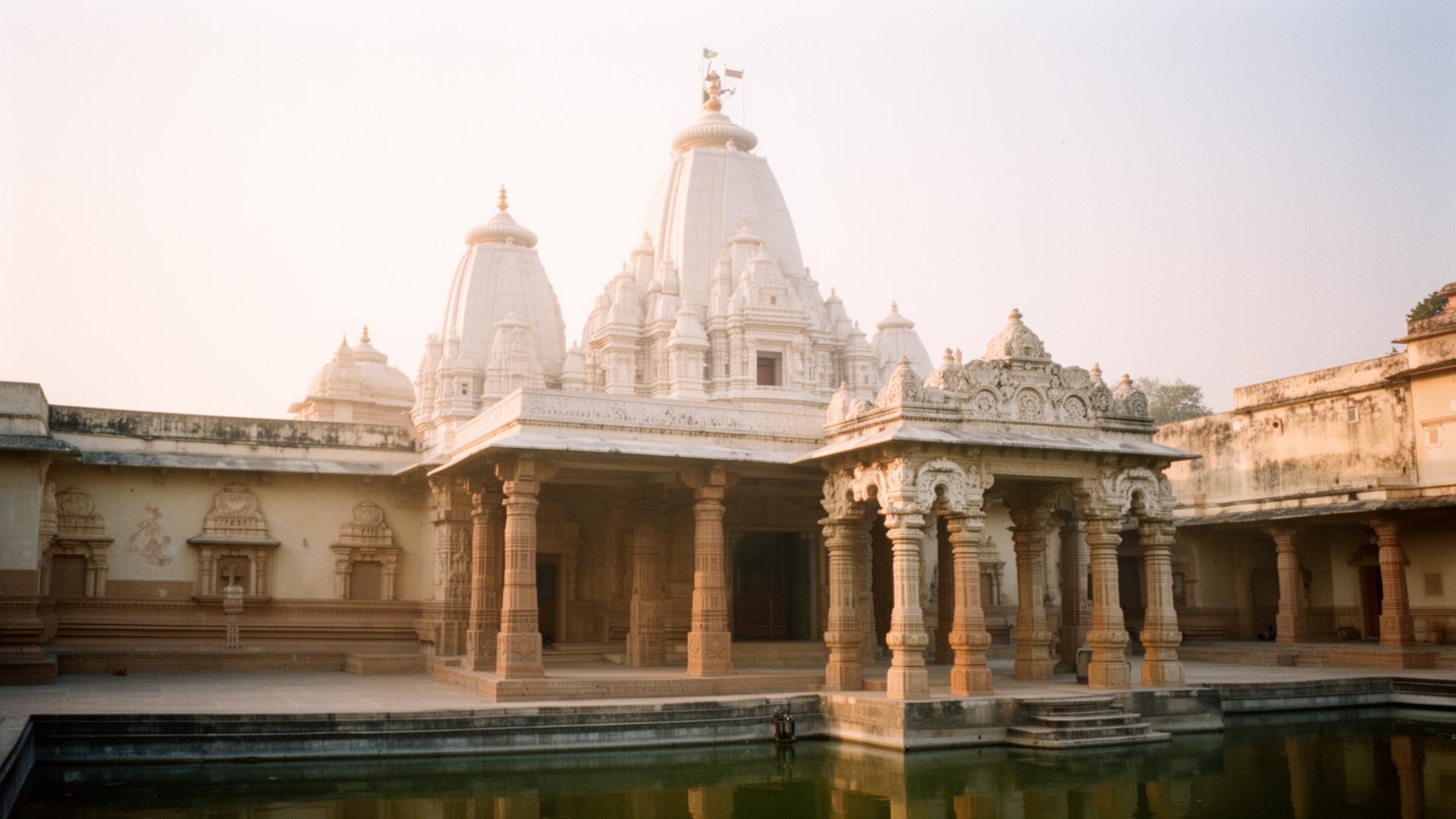
The shrine itself is a compact double-storey structure with a small assembly hall (mandapa), an antechamber (antarala), and a square sanctum (garbhagriha) housing a four-faced black-stone Shiva lingam approximately 1.2 metres tall. The four faces represent four aspects: Brahma to the east, Vishnu to the south, Surya to the west, and Rudra to the north. The fifth, unseen face — Sadashiva, the source — is held to face upward into the sanctum ceiling.
The lingam is clothed in silver repoussé sheathing for most of the day and uncovered only during the dawn abhishekam. The sanctum doorway itself is sheathed in silver, intricately worked with floral and geometric patterns that catch the first light from the eastern windows in a particular slow gold. This is the doorway through which, by tradition, every new Maharana of Mewar has passed at his coronation to receive the formal blessing of the kuladevta. The last to do so was Maharana Bhagwat Singh in 1955.
- Distance from Udaipur
- 22 km north on the NH-48 toward Nathdwara; 45 minutes by car.
- Hours
- Morning: 4:30am–7:00am (best window). Midday: 10:30am–1:30pm. Evening aarti: 5:00pm.
- Entry fee
- Free. Camera not permitted inside the sanctum complex.
- Round-trip taxi
- ~₹1,800–2,400 with two hours waiting time.
- Combine with
- Sas-Bahu temples at Nagda (1 km away, ruined 10th-century Vaishnavite pair) and Haldighati battlefield (35 km further).
Eklingji is not Mewar's most beautiful temple. It is Mewar's ruler.The House of Udaipurs
The Sacred Tank and the Smaller Shrines
Behind the main Eklingji shrine, reached through a small pillared corridor, sits a stone-stepped sacred tank fed by a natural spring. The tank is elliptical, roughly twenty-five metres long, with broad steps descending on three sides and a low parapet on the fourth. At dawn the temple itself is reflected in the still water with such clarity that the reflection appears slightly more solid than the building it doubles.
The tank is bordered by a series of smaller shrines — Mira Bai's small marble shrine on the eastern side (the sixteenth-century poet-saint composed several of her bhajans here); a Hanuman shrine on the southern side; and the small Lakulish shrine on the western side, which houses a Pashupata-tradition image of Shiva as a wandering ascetic and is considered the oldest surviving structure in the Eklingji complex (probably 10th century).
Walk a slow circumambulation around the tank. The complete loop takes about ten minutes at a contemplative pace. At dawn you will share it with perhaps six or seven local pilgrims — almost no visitors come this far past the main shrine — and the only sounds are the slow lapping of the spring-fed water and the temple bells from the inner sanctum behind you.
How to Conduct Yourself
Eklingji is an active devotional shrine, not a museum or a heritage attraction in the conventional sense. The visit asks for some attention to convention, all of which is straightforward.
Dress modestly: covered shoulders and knees for all visitors regardless of religion or gender. Shoes off at the entrance to the main shrine complex (free shoe-rack provided). Photography is forbidden inside the sanctum and inside the main mandapa; outdoor photography around the tank and the smaller shrines is permitted but discouraged during the dawn abhishekam. Mobile phones should be on silent. Non-Hindus are welcome in the outer mandapa and in the tank complex but are traditionally not permitted into the inner sanctum during darshan — you can stand at the silver doorway and look in, which is what the great majority of visitors do anyway.
No offerings are required. If you wish to make one, marigold garlands and small clay diyas are sold at four or five stalls just outside the main entrance for ₹40–80. There is no entry fee, no donation expectation, and no organised guide service inside the temple. The shrine is, in this and in much else, exactly what it has been for a long time.