
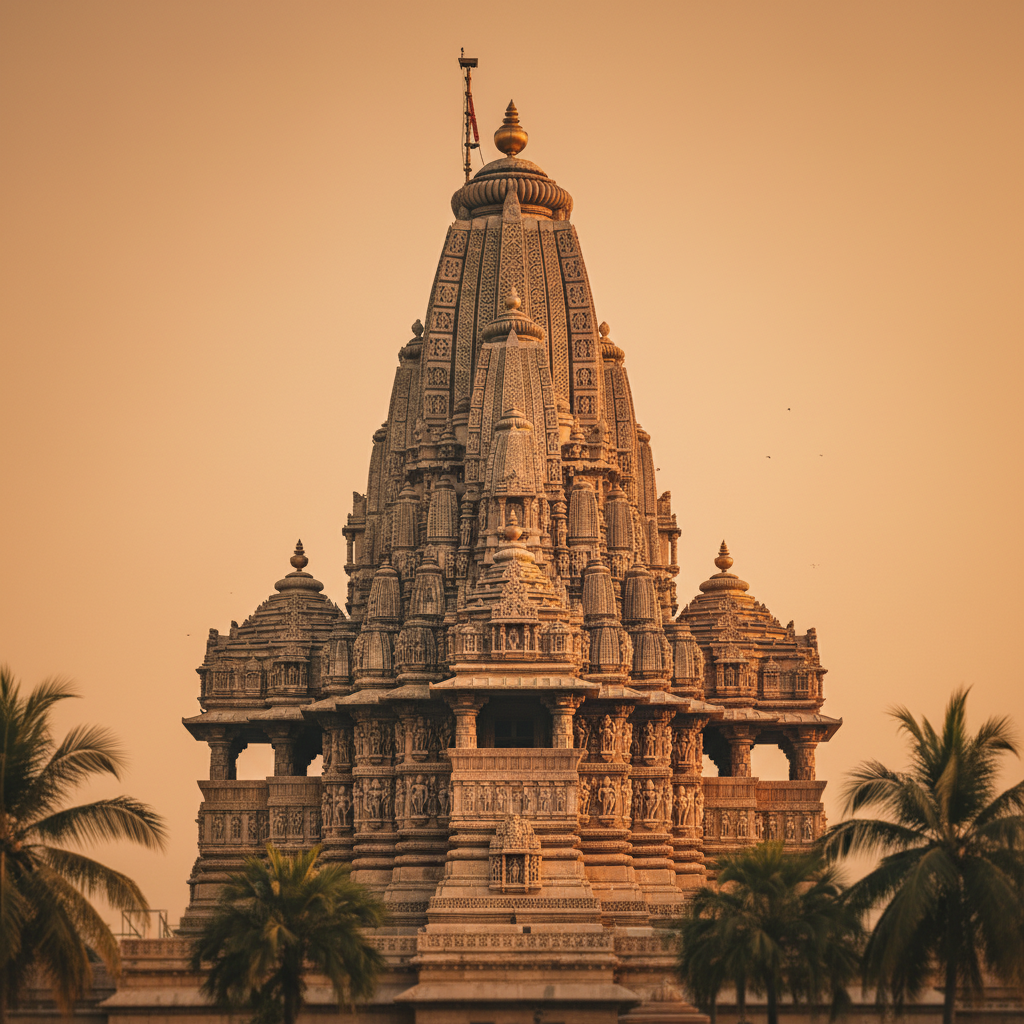
The Year, the Patron, the Reason
Jagdish Temple was completed in 1651 — five years after Maharana Jagat Singh I ascended the Mewar throne — and dedicated to Vishnu in his form as Jagannath, lord of the universe. The temple sits 150 metres north of the City Palace gate and was, by design, the largest temple in Udaipur at the time of its consecration. It still is.
Jagat Singh's reasons were political as much as devotional. His grandfather, Maharana Pratap, had spent his life resisting the Mughal advance. Jagat Singh inherited a stable but cautious Mewar in the 1640s and chose to mark his reign with three large public works: the rebuilding of the Jagmandir island palace on Pichola, the carving of the Bada Mahal in the City Palace, and Jagdish Temple. Of the three, only the temple was a public-facing devotional gift to the city.
It was built quickly — five years from foundation to consecration, which for a temple of this scale was unusually fast in mid-seventeenth-century India. The cost was 1.5 crore rupees in 1651 currency. The labour was three hundred sculptors working in shifts.
The plinth tells you about 1651. The walls tell you about Vishnu. The shikhara tells you that time, in this place, has been kind.The House of Udaipurs
Reading the Plinth
Begin at the bottom. The temple sits on a raised stone plinth (jagati) about 2.5 metres high. The plinth is carved on all four sides with a continuous register of relief panels — this is the temple's historical layer. It depicts elephants, horses, soldiers, processions, and small narrative scenes drawn from contemporary Mewar court life rather than scripture.
The elephants are not symbolic. They are records of specific royal animals from Jagat Singh's stables, identified in court records by their carved earcrops and tusk patterns. The processional figures wear the recognisable Rajput court turban of the 1640s. The two carved guards flanking the western steps carry matchlock muskets — a small but precise dating detail, since matchlocks reached the Mewar court in the early seventeenth century.
The plinth, in other words, was the sculptors' chance to record their own moment. The walls above will tell the timeless story of Vishnu. The plinth tells the story of 1651.
Reading the Walls
Climb the thirty-two steps. The temple's outer walls — the visible exterior of the mandapa and sanctum — carry the second layer: the theological register. Here the carving turns to scripture. You will see the standard Vaishnava cycle: the ten avatars of Vishnu in panels at eye-level on the south wall, scenes from the Bhagavata Purana on the west wall, the Ramayana on the north.
Look closely at the second register up — roughly head-height — on the south wall. The dancers carved here are unusual. They are not standard temple apsaras; their poses are drawn from the actual repertoire of seventeenth-century Mewar court dance, recorded contemporaneously in painted manuscripts. The same dance positions appear in folios held today by the City Palace Museum. The sculptors knew the dancers personally.
On the west wall, look for the small carved figure of a woman holding a lamp, second register from the top, third panel from the corner. She is the only carved figure on the temple known to be a portrait — local tradition holds that she is Maharana Jagat Singh's mother, included in the carving programme by the sculptors as a quiet gift to the king. The portrait identification is not provable. The local belief is four hundred years old.
- Built
- 1646–1651 under Maharana Jagat Singh I; continuously active since.
- Style
- Indo-Aryan / Nagara, Mewar regional school.
- Hours
- Open 4:30am–2:00pm and 4:00pm–10:00pm daily; aartis at 5:30am, 7:30am, 10:30am, 6:30pm, 9:00pm.
- Entry
- Free. Shoes off. Photography permitted in the courtyard, not inside the sanctum.
- Best slow visit
- Just after 7:00am — morning aarti has finished, the courtyard is empty, the morning light rakes the western wall carvings.
A working temple is a strange archive. Nothing is roped off. Everything is still in use.The House of Udaipurs
Reading the Shikhara
The shikhara — the towering pyramidal spire that crowns the sanctum — rises 24 metres above the plinth and is the temple's third and final layer. It is, in the Nagara grammar, the temple's timeless register: the shikhara represents Mount Meru, the cosmic axis. It is carved with miniature replicas of itself stacked one on top of another — a classic Nagara device called shringa.
What is unusual at Jagdish is that the shikhara was repaired three times in its history — in 1798 after a small earthquake, in 1957 after monsoon damage, and in 2003 in a major conservation programme led by ASI. The repaired stones are slightly different in colour from the seventeenth-century originals. Look up from the south-east corner of the courtyard at midday and you can see four distinct generations of stone in the spire above.
The shikhara is the only part of Jagdish Temple that has visibly aged. Everything below it is essentially as the sculptors left it in 1651. That is the slow surprise of the place. It is not a ruin and not a restoration; it is a working temple that simply, patiently, did not break.
How to Visit Slowly
Most visitors spend about ten minutes at Jagdish Temple — the time it takes to climb the thirty-two steps, photograph the two carved elephants flanking the entrance, look briefly into the sanctum, and leave. The slow visit takes thirty to forty.
Arrive at 7:00am, just after the morning aarti. The courtyard will hold perhaps fifteen people. Walk a single slow circumambulation (pradakshina) around the temple — clockwise, as Hindu practice prescribes — and use the four walls as your reading order: south for avatars, west for the Bhagavata Purana, north for the Ramayana, east for the entrance facade. Then sit for ten minutes on the low parapet of the courtyard.
You do not have to be a believer to read the temple. You only have to be slower than the photograph in front of you.